Keep €1,800–€2,400 More: Sell Privately or Trade In in Ireland
Decide whether to trade in or sell privately in Ireland with a money-first framework, real numbers, and a practical checklist to maximize what lands in...

Sell privately if maximising cash matters most; trade in if speed and simplicity matter more. Private buyers typically pay more because they take on no dealer margin or reconditioning risk, but trading in settles the deal in a single visit with far less paperwork and hassle. Which route wins for you depends on how much time, admin and risk you’re willing to absorb for a better price.
TL;DR:
- Trading in your car typically pays 15 to 25 percent less than private sales, but offers greater convenience and quicker transaction completion.
- Private sales can yield roughly 1,800 to 2,400 euros more than trade-ins for similar cars, though they require hours of time and effort.
- When considering private sale value, subtract costs for time, handling outstanding finance, and potential repair or warranty expenses to find the true net profit.
- Getting multiple dealer offers side by side can improve trade-in prices, especially when combined with private listings to test market interest.
- Preparing the car thoroughly with cleaning, documented history, and competing dealer valuations boosts the final sale price regardless of route.
Table of Contents
- Trade in vs sell: quick verdict for your situation
- Trade-in: benefits, drawbacks and what dealers factor into offers
- Private sale: benefits, drawbacks and the real cost of your time
- How do you compare the real net outcome of each option?
- How do you prepare your car to close the price gap?
- What should you ask before accepting any offer?
- What actually happens on the day, step by step
- What sellers consistently get wrong
- Get dealer offers and list privately from one place
- Sources
Trade in vs sell: quick verdict for your situation
You don’t need a spreadsheet to make a sensible first call. A few situations point clearly towards one route or the other, and knowing which camp you fall into saves hours of dithering.
Trade-in usually makes sense when:
- You’re short on time and need the sale wrapped up in a day
- You owe more on finance than the car is worth (negative equity) and want to roll the shortfall into new finance
- You’d rather not deal with strangers, viewings or no-shows
- The car has high mileage, mechanical issues or limited buyer appeal
Private sale usually makes sense when:
- Maximising cash matters more than saving time
- The car is tidy, low-mileage or a sought-after model with genuine demand
- You’re selling a rare, classic or collector car where private buyers pay a premium dealers won’t match
A sensible middle path exists too: list the car privately while you shop for your next one, and fall back on a trade-in offer if private interest doesn’t materialise within a few weeks.
Trade-in: benefits, drawbacks and what dealers factor into offers
Dealers pay less because they’re pricing in risk you never see. Every trade-in has to be reconditioned, checked, warranted and resold at a margin, and if it doesn’t shift quickly it often ends up at auction for less than the dealer hoped.
Trade-in offers typically land noticeably below comparable private-sale prices, according to dealer guidance and marketplace analysis, though the exact gap depends heavily on how many dealers you approach.
What you get in return for that discount:
- One transaction, done in an afternoon, with no strangers walking around your driveway
- Paperwork bundled into the deal, including outstanding finance settlement
- The option to roll negative equity straight into a new finance agreement rather than finding cash upfront
That convenience is real. Whether it’s worth 15 to 25 percent of the car’s value is the actual question you’re answering.
Private sale: benefits, drawbacks and the real cost of your time
Selling privately tends to put more money in your pocket. Matched-transaction analyses show private-party sales can return roughly €1,800 to €2,400 more than a trade-in for a comparable car, though the premium varies by model, condition and how competitive the local market is.
That money doesn’t arrive for free. Expect to spend several hours across days or weeks on:
- Writing the ad, taking photos and answering messages, many from people who never turn up
- Arranging and sitting through viewings, often repeatedly for the same car
- Verifying buyer funds and meeting somewhere safe, ideally a bank, to avoid fraudulent transfers
Private sale stops making sense once the car has high mileage, a known mechanical fault, or simply isn’t in demand. In those cases, the extra weeks of advertising rarely produce the premium the maths promised.
How do you compare the real net outcome of each option?
Comparing a trade-in offer against a private-sale estimate on price alone is the mistake most sellers make. The number that matters is what lands in your account after every cost is subtracted, not the headline figure either side quotes you.
- Start with the trade-in offer in writing. This is your baseline, and it’s the only number that’s guaranteed.
- Estimate a realistic private-sale price, not the optimistic one, using recent sold listings for the same make, model, year and mileage.
- Subtract your time. If selling privately will eat ten hours of your evenings and weekends, put a rough value on that time and deduct it from the private-sale figure.
- Account for outstanding finance. A trade-in settles it directly; a private sale means you clear the loan yourself before or during the handover.
- Factor in NCT and warranty costs. A car close to its NCT expiry may need work to sell privately at a good price, while a dealer will absorb that cost into their offer.
- Check for tax exposure. Private individuals selling their own car generally have no VAT or capital gains liability in Ireland, unlike dealers, so this rarely swings the decision but is worth confirming for unusual cases.
A rough rule of thumb: if the private-sale premium after subtracting your time and costs falls below roughly €1,000, the certainty of a trade-in is often the better trade, according to scenario-based guidance on when trade-ins outperform private sales.
How do you prepare your car to close the price gap?
Presentation and paperwork do more heavy lifting than most sellers expect, and the improvements cost little beyond time.
Get the basics right before anyone sees the car:
- Clean it properly inside and out, and fix small cosmetic issues like scratches or a cracked mirror
- Take clear daylight photos from multiple angles, including the interior and boot
- Write an honest description that states mileage, NCT expiry and any known issues upfront
Then get your paperwork in order:
- Gather your full service history, NCT certificate, motor tax receipt and both sets of keys
- Pull an independent valuation from Cartell before you talk to anyone, so you have a figure to negotiate against
- Approach at least three dealers rather than one, since competing offers on the same car commonly spread by €1,000 to €2,000
Pro Tip: Get your Cartell valuation before your first dealer conversation, not after. Walking in with a printed figure changes the tone of the negotiation immediately.
For a fuller checklist on lifting your valuation further, see how to get the best trade-in value in Ireland.
What should you ask before accepting any offer?
Whether you’re facing a dealer or a private buyer, the questions you ask before signing anything determine whether you’re leaving money on the table.
- Ask for the offer in writing, with a validity period stated, so it can’t quietly shrink when you turn up.
- Ask what the offer is subject to. Many dealer quotes are conditional on inspection, and you want to know what could change the number.
- Mention you have other offers. A dealer who knows you’re comparing quotes has a reason to sharpen their number.
- Be willing to walk away. The single strongest lever in any negotiation is not needing the deal to happen today.
- Verify funds before you hand over keys. Insist on a bank transfer you can see cleared, or meet at your own bank branch for cash.
What actually happens on the day, step by step
The two routes look similar on paper but play out very differently in practice.
Trade-in: the dealer appraises the car, confirms the offer, settles any outstanding finance directly with your lender, and you sign over the vehicle and drive away in the replacement. Most of this happens in a single visit.
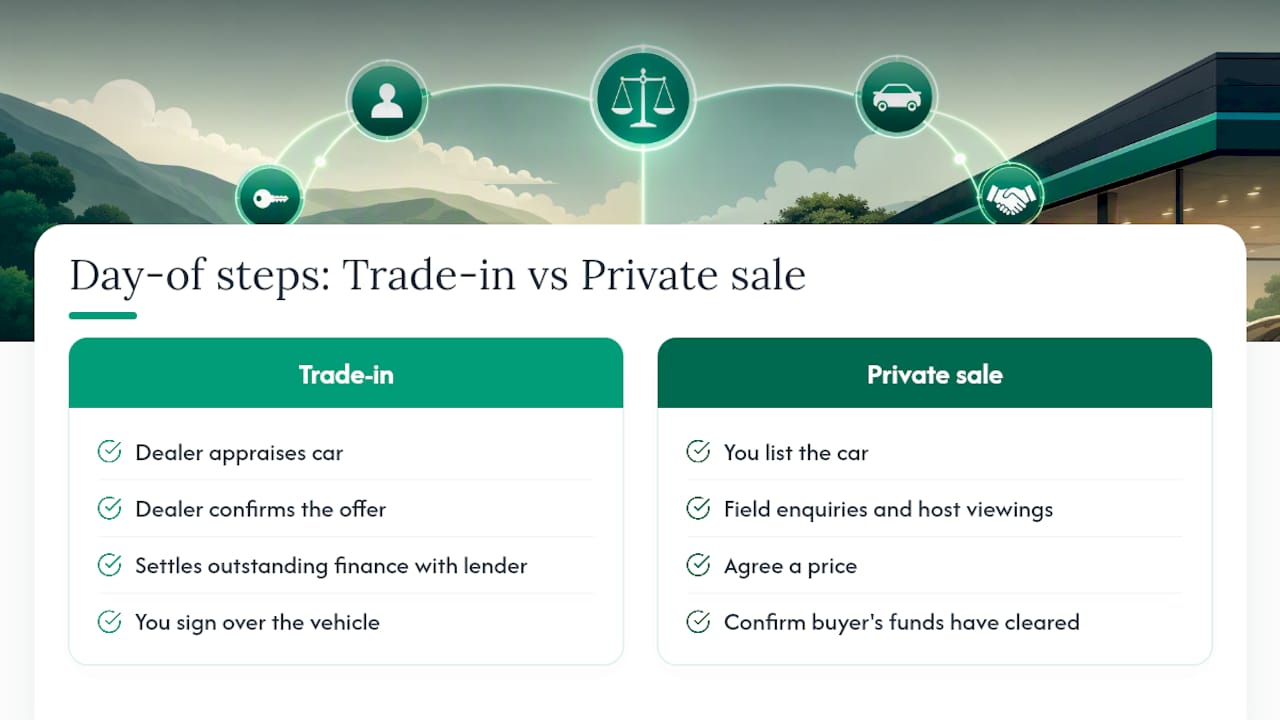
Private sale: you list the car, field enquiries, host viewings, agree a price, confirm the buyer’s funds have cleared, then sign the ownership document, notify motor tax of the change, and cancel or transfer your insurance. Budget a few weeks from listing to handover, not a single afternoon.
What sellers consistently get wrong
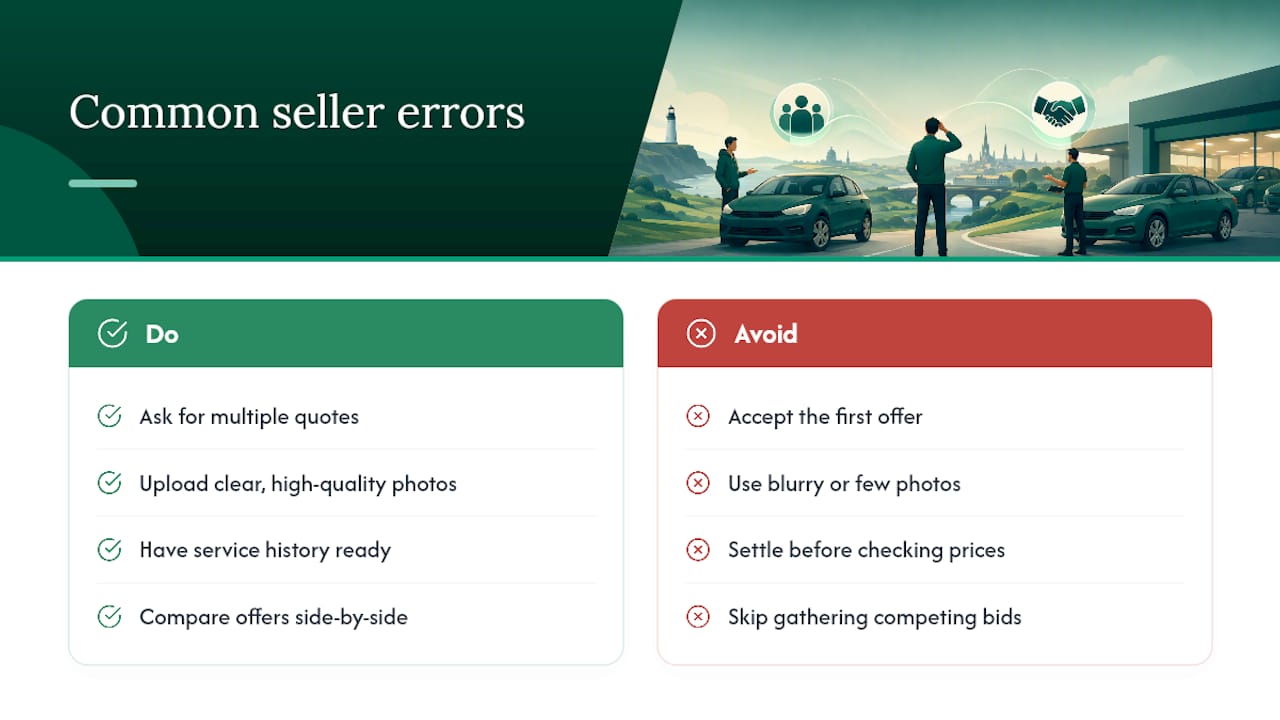
Most sellers accept the first number they’re offered because asking for a second quote feels awkward. It shouldn’t. The spread between dealer bids on the identical car is often hundreds, sometimes thousands, of euros.
The recurring mistakes are predictable: blurry photos, no service history to hand, and settling before checking what else is out there. Platforms that let you gather several offers side by side remove the guesswork and put the negotiating power back where it belongs, with you.
— ibrahim
Get dealer offers and list privately from one place
Comparing routes is easier when you’re not juggling three phone calls, a classifieds account and a stack of paper valuations. Ecosteer is built for exactly this decision: it lets you invite competing offers from dealers and list your car privately from a single dashboard, so you can see both numbers side by side before you commit to either.
That side-by-side view is what narrows the gap between trade-in convenience and private-sale money. Instead of accepting the first dealer figure, you can push several dealers to compete, while keeping a private listing running in parallel to test genuine market interest. Paperwork links and buyer verification sit inside the same flow, so you’re not juggling separate systems for each route. If you’d rather skip the single-buyer lowball offer altogether, find a car dealer through Ecosteer and see what real competition does to your number, or head to Ecosteer to list your car and start comparing offers today.
Sources
- Selling Your Car to a Dealer in Ireland: Is It Worth It? | Car Spot
- Trade-In vs. Sell to Private Party: The $2,200 Decision (2026) | CarSavr
- Cars
- Trade-In Vs Selling Car Ireland: Maximising Your Car’s Value - autobuyer
Recommended
Ecosteer Editorial
Author