3 Ways to Sell a Financed Car in Ireland and Clear the Lien
Irish checklist to sell a car with finance: get a written lender payoff, confirm VRC transfer, and pick private sale, trade in, or an online buyer.

Yes, you can sell a car with finance still outstanding in Ireland, but the lender’s interest in the vehicle must be cleared before ownership legally passes to a buyer. The first move, before you photograph the car or list it anywhere, is to ring your finance provider and request a written payoff figure with a valid “good through” date. From there, you have three practical routes: sell privately, trade it in with a dealer, or use an online buyer that handles settlement for you.
TL;DR:
- Selling a financed car requires obtaining a written payoff figure from the lender, including accrued interest and potential early repayment charges, before ownership transfer.
- The lender’s interest must be fully settled and confirmed released before the vehicle’s ownership and registration documents are handed over to avoid legal liability.
- Private sales typically yield the highest return but involve coordinating with the lender, buyer, and possibly meeting at a bank branch to complete settlement and transfer paperwork.
- Dealers manage loan settlement during trade-ins, offering convenience at the expense of lower trade-in values, while online buyers may handle payoff processes internally but vary in availability.
- If there is negative equity, it must be covered through cash, a personal loan, or rolled into a new finance deal, with the latter often increasing total costs and loan duration.
Table of Contents
- Who legally owns the car and why the lender must be involved
- How to sell a car with finance: the step-by-step workflow
- Private sale, trade-in, or online buyer: which suits you?
- Dealing with negative equity when you owe more than the car’s worth
- Paperwork checklist for selling a financed car in Ireland
- Expert tips from Ecosteer on selling a financed car
- Your legal obligations when selling a car under finance
- Does outstanding finance affect the price you can negotiate?
- Paying off finance early: lump sum or refinance first?
- What happens if you sell without lender approval?
- Protecting yourself from fraud or buyer default
- When to sell now versus when to wait
- List your financed car with Ecosteer
- Sources
- FAQ
Who legally owns the car and why the lender must be involved
When you finance a car through hire purchase (HP) or a PCP agreement, you’re not the legal owner yet. The finance company owns the vehicle until the final payment clears, and you’re technically a borrower with permission to use it. A personal loan works differently. If you borrowed cash from a bank or credit union to buy the car outright, you own it from day one, and the lender simply has a claim against you as a debtor, not against the vehicle itself.
That distinction matters when you come to sell.
- HP/PCP agreements: the finance company’s name may not appear on the Vehicle Registration Certificate (VRC), but their financial interest still blocks a clean sale until settled.
- Personal loans secured against the car: the lender may still hold a lien even though you’re the registered owner.
- Unsecured personal loans: rarer for car purchases, these carry no lien at all, so selling is straightforward.
Either way, you cannot legitimately hand a buyer a car free of encumbrance until the payoff has been made and the lender confirms their interest is discharged. Selling around that obligation isn’t just risky. It can leave you liable even after the car has changed hands.
How to sell a car with finance: the step-by-step workflow
Selling a financed car in Ireland follows a fairly predictable sequence once you know what to ask for and when.
- Contact your lender first. Ask for a written settlement figure, not just your outstanding balance. The payoff amount often includes accrued interest and, occasionally, an early repayment charge, so it’s rarely identical to the number on your last statement.
- Ask about their process. Some lenders require branch sign-off before releasing their interest; others post the VRC or discharge paperwork by mail once payment clears. Ask how long this takes so you’re not left explaining delays to an impatient buyer.
- Get a real market value. Check what similar cars are fetching privately versus what a dealer would offer as a trade-in. The gap between the two figures often surprises sellers.
- Calculate your equity. Subtract the payoff figure from the realistic sale price. A positive number means you’ll walk away with cash; a negative one means you owe more than the car is worth.
- Agree terms and settlement method. A private buyer might pay the lender directly at a branch appointment. A dealer typically settles the loan on your behalf as part of the trade-in. An online buyer usually coordinates the payoff internally.
- Confirm the lien release and keep the receipt. Only transfer the VRC once you have written confirmation the loan is cleared.
Pro Tip: Ask your lender for the “good through” date on the payoff figure before you agree a sale price with anyone. Interest accrues daily, and a quote that’s two weeks old can be inaccurate by the time you’re ready to complete.
Private sale, trade-in, or online buyer: which suits you?
The route you choose depends on how much cash you need and how much hassle you’re willing to absorb.
- Private sale usually returns the most money, but it demands more coordination. You, the buyer, and sometimes the lender need to align on timing, and meeting at a bank branch to sign paperwork and clear the lien is common practice for financed vehicles.
- Dealer trade-in is the path of least resistance. The dealer typically deals directly with your finance company, settles the loan, and applies any leftover equity toward your next car. You’ll almost certainly get less cash than a private sale would deliver, but the paperwork burden shifts to someone else.
- Online buyers increasingly handle payoff and title paperwork as part of their standard process, though availability and exact procedures in Ireland vary, so confirm details before assuming a service covers your situation.
If you’re sitting on positive equity and have some flexibility, a private sale or listing through a platform that connects you with genuine buyers tends to pay off. If you need speed, or you’re underwater on the loan, trade-in convenience often outweighs the lost cash. Comparing private sale proceeds against trade-in values before committing to either route is worth the ten minutes it takes.
Dealing with negative equity when you owe more than the car’s worth
Negative equity simply means your payoff figure is higher than what the car will fetch. If your settlement quote is higher than the best offer you can find, you’re short and that gap has to be covered somehow.
- Pay the shortfall in cash, if you have savings set aside, which closes the loan cleanly with no new debt attached.
- Take a personal loan specifically to cover the gap, ideally at a lower rate than rolling it into new car finance.
- Roll the negative equity into a new finance agreement. Dealers routinely offer this, but it increases your new loan balance and stretches out the time before you’re back in positive territory. Understanding how negative equity compounds over a loan term helps before you sign anything.
Before accepting a rollover, ask for a written example showing the new monthly payment and total cost over the full term, then compare it against a standalone personal loan. The numbers rarely favour the rollover once you actually see them side by side.
Paperwork checklist for selling a financed car in Ireland
Get these documents lined up before you meet a buyer, not after.
- Written payoff/settlement statement from your lender, with a valid date, confirming the exact figure required to clear the loan.
- Payment receipt once the settlement is made, proving the lender has actually received the funds.
- VRC transfer paperwork, registering the new owner through the standard Irish vehicle registration process once the lien is cleared.
- Insurance and motor tax notifications, updating the relevant records so you’re not left liable for a car you no longer own.
- Signed contract of sale, kept alongside your payoff confirmation and VRC evidence as your permanent record of the transaction.
Completing the settlement at the lender’s branch, or through a verified payment path, gives buyers real confidence that the loan has actually been cleared, rather than taking your word for it. For the mechanics of transferring registration itself, our guide on completing a VRC transfer walks through the same-day process step by step.
Expert tips from Ecosteer on selling a financed car
The turnaround time on a lender’s lien release is the single biggest variable in how smoothly a financed sale goes, and it’s worth chasing hard. Some lenders release their interest within days of receiving cleared funds; others take longer if the request goes through a general customer service queue rather than a dedicated settlements team.
The most common mistake sellers make is listing the car before they’ve even rung the lender, then discovering the payoff figure is thousands more than expected. The second most common mistake is handing over keys before a receipt confirms the loan is cleared. Neither costs anything to avoid.
Your legal obligations when selling a car under finance
Selling a car you don’t fully own yet carries real legal weight, not just a procedural inconvenience. Under a finance agreement, particularly HP or PCP, the finance company retains a legal interest in the vehicle until the final payment clears. Selling it without settling that interest, or without the lender’s knowledge, can expose you to a claim for the outstanding balance even after the car has left your driveway.
Practically speaking, your obligation is to ensure the lender’s interest is fully discharged before the buyer takes possession, and that the sale contract reflects the true state of the vehicle. Misrepresenting a financed car as free of encumbrance to a buyer, even unintentionally, can create liability for you if the lender later pursues the vehicle or the debt.
It’s also worth being transparent with the buyer from the outset. Most buyers, private or dealer, expect to hear that finance is still outstanding, and reacting calmly with a clear payoff figure in hand builds far more trust than trying to hide it. Dealers in particular are used to this scenario and have standard procedures for settling loans as part of a trade-in.
None of this needs to be complicated. The obligation boils down to one principle: don’t transfer ownership until the lien is gone, and be upfront about the loan’s existence throughout the process. Sellers who follow that simple rule rarely run into legal trouble.
Does outstanding finance affect the price you can negotiate?
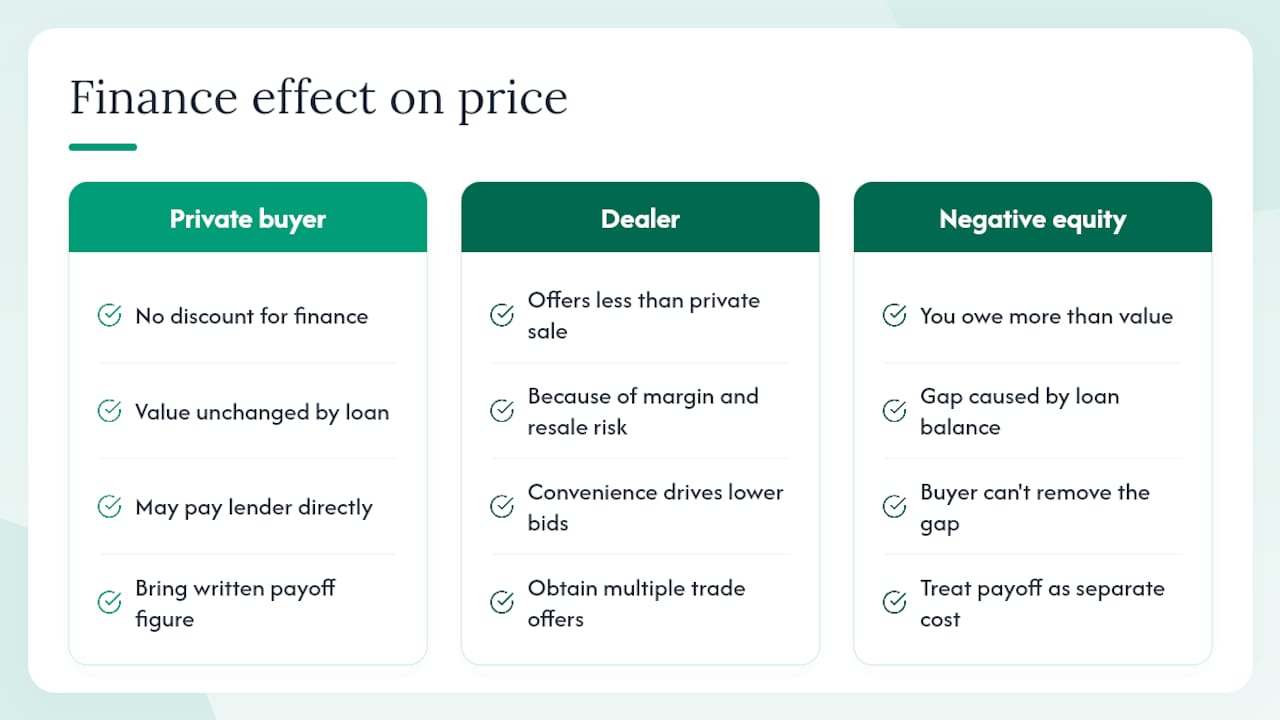
It can, and buyers who spot outstanding finance sometimes use it as leverage to push for a lower price, assuming you’re desperate to offload the car and clear the debt. Don’t let that assumption drive the negotiation.
A car with finance still owing is worth exactly the same on the open market as an identical car with no finance attached. What differs is the process, not the value. A buyer paying the lender directly at a branch appointment, rather than handing cash straight to you, shouldn’t expect a discount for that extra step. If anything, a seller who arrives with a written payoff figure and a clear plan for settlement looks more organised and trustworthy than one who’s vague about the loan situation.
Where price pressure genuinely applies is with dealer trade-ins, and that’s down to convenience, not the finance itself. Dealers offer less than private sale value regardless of whether a car is financed, because they’re pricing in their own margin and resale risk. Getting multiple trade-in offers before accepting one protects you from settling for a lowball figure out of convenience.
The one scenario where finance genuinely limits your negotiating position is negative equity. If you owe more than the car’s worth, you can’t negotiate your way out of that gap. It has to be covered somehow. But that’s a function of the loan balance, not something a savvy buyer can talk you down further on. Hold your price on the car’s actual value and treat the payoff as a separate, fixed cost of doing business.
Paying off finance early: lump sum or refinance first?
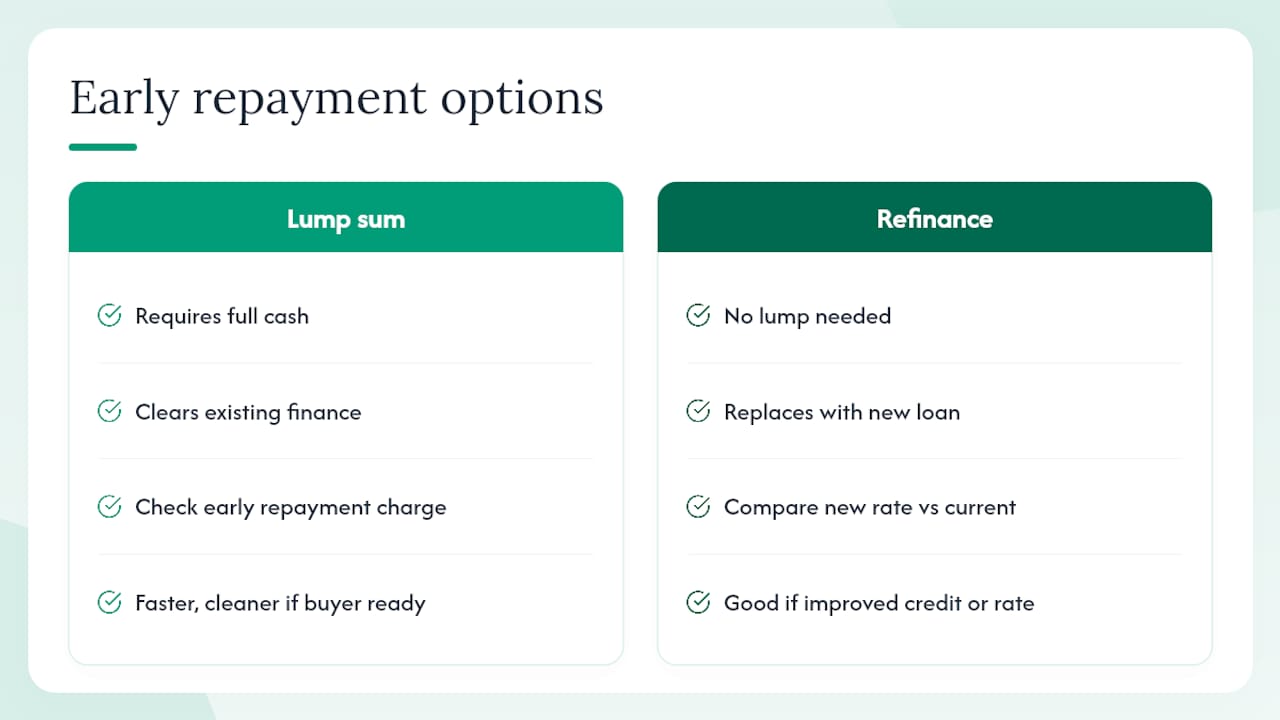
If you’d rather clear the loan before selling, you have two realistic paths, and they suit different financial situations.
A lump sum settlement is the simplest option if you have the cash available. You pay the lender the full settlement figure, they release their interest, and you own the car outright with nothing left to negotiate around. The main thing to check is whether an early repayment charge applies. Most Irish lenders will confirm this on request, and it’s usually a modest percentage of the remaining balance rather than a punitive fee, but it’s worth knowing before you commit.
Refinancing makes more sense if you don’t have a lump sum ready but want to sell sooner rather than later. This means taking out a new loan, often at a lower rate if your credit position has improved since the original agreement, specifically to clear the existing finance. You then own the car cleanly and can sell whenever suits, though you’re carrying the new loan until you do.
Refinancing only makes financial sense if the new rate is genuinely better than your current one, or if the flexibility of owning the car outright is worth the interest cost to you. Run the numbers on both the remaining term of your current agreement and the proposed refinance before deciding. For most sellers with a straightforward HP or PCP balance and a buyer already lined up, a direct lump sum settlement through the existing lender remains the faster, cleaner option.
What happens if you sell without lender approval?
Selling a financed car without settling or informing the lender first isn’t just against the terms of most agreements. It can create serious problems for both you and the buyer.
The finance company retains a legal interest in the vehicle until the loan is cleared, which means they can, in some circumstances, pursue the car itself, not just you, if the debt remains unpaid. That’s a nightmare for a buyer who’s paid you in good faith and now finds a third party with a claim on their newly bought car. It’s equally bad for you, since you may still owe the balance even after handing over the keys and pocketing the sale price.
There’s also a straightforward practical risk: without lender involvement, you have no clean way to transfer the VRC, because you were never in a position to offer clear title in the first place. A buyer who later discovers the finance situation, whether through a vehicle history check or the lender itself, has grounds to unwind the sale or pursue you for misrepresentation.
The safest position is always the same: settle or arrange settlement with the lender before the car changes hands, and never take a shortcut on this step because a buyer is in a hurry or offering slightly more for a quick, informal handover. The time saved rarely justifies the exposure it creates.
Protecting yourself from fraud or buyer default
Most private car sales in Ireland go smoothly, but a financed vehicle adds an extra layer where things can go wrong if you’re not careful about how payment and settlement are handled.
Never hand over the keys, the VRC, or any paperwork until funds have actually cleared, not just been promised. Bank transfers can be reversed or disputed in the days after they appear to land, so waiting for confirmed, cleared funds before finalising anything protects you from a buyer who pays and then claims fraud to reverse the transaction.
Meeting at your lender’s branch to complete the payoff, where the buyer pays the lender directly, removes a huge amount of risk because the money goes straight to clearing the loan rather than passing through your hands first. This also reassures the buyer that the lien is genuinely being cleared, not just promised.
Be wary of buyers who push to complete outside normal banking hours, who offer to overpay and want the difference refunded, or who pressure you to skip the lender step entirely “to save time.” These are recognised patterns in vehicle sale scams. A buyer with nothing to hide will have no objection to a properly documented, lender-verified settlement process. Keep every text message, email confirmation, and receipt until the sale is fully closed and the VRC transfer confirmed.
When to sell now versus when to wait
Sell now if you’re sitting on positive equity or you genuinely need the cash or car change urgently. If you’re underwater, it’s usually worth paying down the balance or waiting for the market to close the gap rather than selling at a loss. Resist the temptation to routinely roll negative equity into a bigger loan just to move on faster.
— ibrahim
List your financed car with Ecosteer
If you’ve worked through your payoff figure and equity position and you’re ready to move, The platform gives sellers a faster route to real buyers than waiting on a single dealer quote or fielding private enquiries one at a time. You can list the car yourself with full details on mileage, county, and price, or browse dealers set up to handle financed sales and settlement paperwork without you having to chase each one individually.
Whether you’re weighing a private sale against a trade-in, our comparison of private sale versus dealer routes in the Irish market can help you settle on the right path before you commit. When you’re ready, list your car on Ecosteer and start comparing genuine offers from buyers and dealers across Ireland.
Sources
For lender payoff procedures and selling mechanics referenced throughout this guide, see Experian’s guide to selling an unpaid car and J.D. Power’s overview of trade-in settlement.
- How to sell a car if it isn’t paid off | Experian
- How to sell a car that is not paid off | J.D. Power
- How to sell your car when you still have a loan | NerdWallet
- Selling a Car with a Loan | Carvana
FAQ
Can you sell a car on finance in Ireland?
Yes. The lender’s interest must be settled before ownership transfers, so you’ll need a written payoff figure and confirmation the loan is cleared before handing over the VRC.
What’s the best way to sell a financed car?
Contact your lender first for a written settlement figure, then choose between a private sale for more cash, a dealer trade-in for convenience, or an online buyer that handles the payoff directly.
Can I trade in my car with outstanding finance in Ireland?
Yes, most dealers routinely handle trade-ins on financed cars by settling the outstanding loan themselves and applying any leftover equity toward your next purchase.
Can I cancel my car finance and give the car back?
Some HP and PCP agreements include a voluntary termination or “hand back” clause once you’ve paid a set proportion of the total amount payable, but this depends entirely on your specific agreement, so check the terms with your lender directly rather than assuming it applies.
Recommended
Ecosteer Editorial
Author