Respond to Car Leads in 5 Minutes to Win Appointments for BDCs
Dealership BDCs: reply in five minutes, use scripts, and run a 30-day cadence with 10 to 15 touches to win more showroom appointments.

Respond within five minutes and follow a multi-channel 30-day cadence. That is the single change that reliably lifts contact rates and showroom appointments. If a human cannot pick up the phone that fast, send an instant, personalised acknowledgement within two minutes, naming an agent and promising a call within ten. The first reply’s job isn’t to close the sale, it’s to earn the next conversation. A platform like Ecosteer gives dealers the lead inbox and tools to make that happen consistently.
TL;DR:
- Respond within five minutes to car leads, as contact rates drop sharply after this window, significantly reducing the likelihood of conversion.
- Use tailored, channel-specific responses that are short, focused, and end with a question to encourage engagement without pressure.
- Follow up persistently with 10 to 15 touches over 30 days across multiple channels to maximize lead conversion rates.
- Automate lead routing and escalation with AI-driven tools to ensure speedy follow-up without overloading staff.
- Track key metrics such as contact time, response speed, and appointment show rates weekly to identify and fix response process weaknesses.
Table of Contents
- Why speed matters when you respond to car leads
- What should your first reply to a car lead say?
- Building a 30-day follow-up cadence that actually gets answered
- The tech stack that makes the five-minute SLA repeatable
- Measuring what matters after you respond to car leads
- Fixes for the mistakes that quietly kill conversion
- How Ecosteer supports faster lead response for dealers
- What the data actually tells dealers to prioritise
- Get your dealership set up to respond faster on Ecosteer
- Sources
Why speed matters when you respond to car leads
The data on this is blunt. Companies that contact a lead within an hour are seven times more likely to qualify it than those that wait longer, and the biggest jump in contact likelihood happens during the first five minutes. Wait past 15 or 30 minutes and conversion drops sharply, often to a fraction of what fast responders achieve.
Cars sold within five minutes of a lead landing convert at materially higher rates than those contacted after several hours, with a significant drop in conversion beyond the initial minutes, according to industry analysis of digital shopper behaviour. That gap exists because car buyers rarely enquire with just one dealer. A shopper filling in a form on a Saturday morning has probably submitted three or four similar enquiries within minutes of each other, and whoever calls first usually gets the appointment.
Not every lead source behaves the same way, though. A live chat conversation carries an expectation of an immediate reply, effectively seconds, because the buyer is sitting at their screen waiting. A web form submitted at 11pm carries a different, more forgiving expectation, but the buyer still moves on quickly the next morning if nobody calls. Third-party marketplace leads tend to be the most competitive of all, since the buyer has likely clicked through to several dealers from the same listing page.
The operational lesson is to set different service levels by source rather than treating every lead the same; this approach mirrors the efficient process seen in selling an electric car on the same day with quick turnaround and customer satisfaction. Chat and phone enquiries need an answer in seconds or a minute or two at most. Form and marketplace leads need contact inside five minutes, full stop. Anything slower and you’re not really in the race anymore, you’re hoping the buyer didn’t find what they wanted elsewhere first.
What should your first reply to a car lead say?
The structure that works is short, specific, and ends with a question, not a pitch. Five elements belong in every first response, whichever channel you use:
- A greeting that uses the buyer’s actual name, not “Dear Customer” or “Hi there”
- A direct reference to the exact vehicle they enquired about, including trim or registration where you have it
- One quick piece of value, such as availability confirmation or a trade estimate offer
- A single, specific question that invites a reply
- A named contact with a direct phone number, not a generic dealership line
Skip the sales language entirely at this stage. No “great deal,” no “won’t last long,” no discount mentions. That kind of pressure reads as generic to a buyer who has heard it from every dealer they’ve contacted, and it does nothing to earn a reply.
Here are three scripts built to that structure.
Phone opener (20 to 30 seconds): “Hi, is that [Name]? This is [Agent] from [Dealership], calling about the [Year Make Model] you enquired about a few minutes ago. It’s still available and I’ve got the full spec in front of me. Are you looking to view it this week, or do you have a couple of questions first?”
SMS acknowledgement (15 to 25 words): “Hi [Name], it’s [Agent] at [Dealership] re: the [Model]. Still available. What time suits a quick call today?”
Email template (60 to 90 seconds to write): Subject: “Your enquiry about the [Year Make Model].” Body: “Hi [Name], thanks for your enquiry about the [Model] on [source]. It’s currently in stock and I can pull together trade-in and payment options before we speak. What’s the best number to reach you on today? [Agent name, direct line, photo].”
Pro Tip: Spending 60 to 90 seconds pulling trade and payment scenarios before you dial the phone, rather than during the call, makes the conversation sound prepared rather than scripted. If you can’t get exact numbers ready in time, promise them within 30 minutes and actually deliver.
Adding an agent photo to email and SMS templates, where your system supports it, consistently makes replies feel less like automation and more like a person who’s genuinely available.
Building a 30-day follow-up cadence that actually gets answered
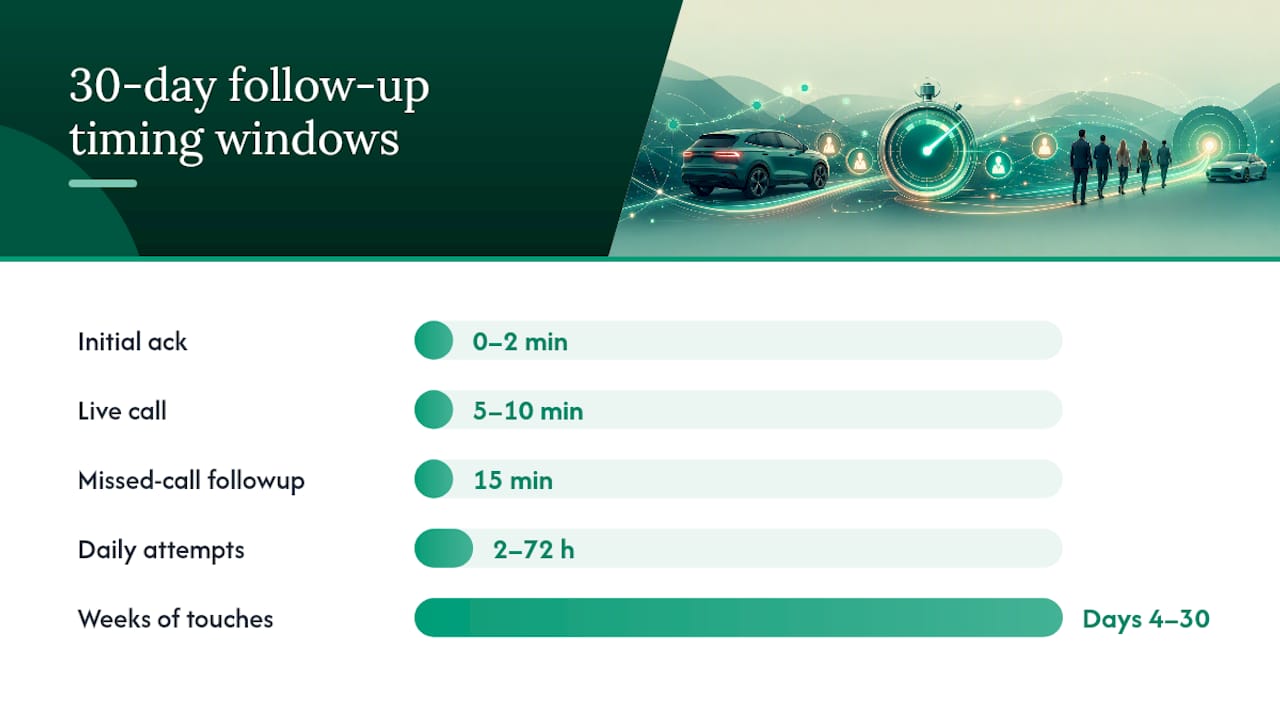
Speed on the first touch only pays off if you back it up with persistence. Top-performing dealers follow up 10 to 15 times over 30 days across phone, email, text, video and social, and convert 25 to 30% of the leads they work this way, according to multi-touch sequence data from industry guides. Most dealers give up after two or three attempts, which is exactly why the ones who don’t win disproportionately more business.
A workable 30-day sequence looks like this:
- 0 to 2 minutes: automated acknowledgement naming the agent and vehicle, setting expectation of a call within 10 minutes.
- 5 to 10 minutes: live call attempt.
- 15 minutes (if no answer): follow-up SMS or email referencing the missed call and vehicle.
- Hours 2 to 72: daily contact attempts at varied times of day, alternating call, text, and email so you’re not hitting the same channel repeatedly.
- Days 4 to 30: two to three touches per week, each carrying a different piece of value, then a monthly nurture message once the buyer has gone quiet.
Vary what each touch actually offers rather than repeating “just checking in.” A trade valuation estimate works well on day two. A short video walk-round of the vehicle lands well around day five or six, when the buyer is comparing options. A direct appointment scheduling link removes friction around day eight or nine, once they’ve had time to think it over. Payment or finance options tend to land best in the second week, when price becomes the real question.
Pro Tip: Stagger call times across the day rather than always calling at 10am. A buyer who missed your morning call might answer instantly at 4pm, and varying the time signals persistence rather than a scripted robocall pattern.
The tech stack that makes the five-minute SLA repeatable
None of this holds up under real lead volume without automated routing and escalation behind it. Manual triage collapses the moment three leads land in the same ten minutes, which happens most weekends.
The core pieces to have in place:
- Automated acknowledgement on submission, naming the agent assigned and the vehicle enquired about, so the buyer knows a real person is already on it.
- Auto-routing to the next available agent, with a fallback queue if the first agent doesn’t act within a set window.
- Supervisor alerts that fire when a lead sits unworked past your SLA threshold, not after it’s already gone cold.
- Mobile push notifications so agents can respond from the floor or on the road, not just from a desk.
- AI-based triage by intent signal, distinguishing a credit-qualified, ready-to-buy enquiry from a general researcher, so your most experienced agent gets the highest-intent lead first.
Coverage of AI adoption in dealerships shows this shift is accelerating. New AI-driven follow-up tools are giving dealers instant acknowledgement, intelligent routing, and multi-channel persistence without adding headcount. The right way to use them is as augmentation, not replacement. An automated sequence should pause the moment a buyer replies or engages, handing straight back to a human, because a bot that keeps texting after someone has already responded to a person undoes the trust you just built.
Leads contacted within five minutes convert at materially higher rates than those left waiting even 15 to 30 minutes, and that gap is exactly what routing and escalation rules are built to protect, according to response time research from the same guide. Telephony and SMS integration into your CRM is what makes the whole sequence loggable and coachable, rather than scattered across personal phones.
Measuring what matters after you respond to car leads
You cannot improve what you don’t track at the individual lead level. Six metrics belong on every BDC dashboard:
| Metric | What it tells you | Target to aim for |
|---|---|---|
| % of leads contacted under 5 minutes | Core SLA compliance | 25 to 30% |
| Median response time | Overall team speed, not skewed by outliers | Under 5 minutes |
| Contact rate | How many leads you actually reach, not just attempt | Track weekly by source |
| Conversion by response-time bracket | Proves the SLA’s value with your own numbers | Compare <5 min vs 30+ min |
| Touches per lead before contact or close | Whether persistence rules are being followed | 10 to 15 over 30 days |
| Appointment show rate | Whether contact is translating into showroom visits | Track by agent and source |
Review these at both agent and team level weekly, and break results down by lead source, since a marketplace lead and a walk-in web enquiry rarely perform the same way. When an agent’s under-5-minute rate drops below your threshold for two consecutive weeks, that’s a coaching trigger, not a one-off note. Pair the dashboard review with a short call listening session, because response time numbers tell you what happened but not why a particular script or tone wasn’t landing.
Fixes for the mistakes that quietly kill conversion
A handful of avoidable errors show up again and again in dealership lead handling, and each one has a fast fix.
- Generic auto-responses with no name or vehicle reference feel like spam. Fix it by templating the vehicle and agent name into every automated message, not just the human follow-up.
- Giving up after two or three attempts throws away most of the value in the lead. Fix it with a scheduled, systematic cadence that runs the full 30 days regardless of how the first few touches go.
- Inaccurate inventory data damages credibility the moment a buyer discovers the car sold last week. Fix it by integrating your DMS and vehicle detail pages directly with your CRM so listings and lead responses always match live stock.
How Ecosteer supports faster lead response for dealers
Ecosteer’s 30-day dealer plan for generating car sales leads sets out exactly this five-minute follow-up discipline in a step-by-step format built for Irish dealers. The platform’s lead inbox and dealer tools, detailed in Ecosteer’s marketplace overview, are built to help you route and act on enquiries without the manual scramble. If your listing copy also needs sharpening to attract better-qualified leads in the first place, three ad templates that bring serious buyers is worth a read too.
What the data actually tells dealers to prioritise
The conventional advice in this industry tells dealers to buy better leads or spend more on advertising. The research doesn’t really back that up. It says the leads you already have are converting far below their potential because of how slowly and how few times you follow up on them. That’s an operations problem, not a marketing spend problem, and it’s fixable this week rather than next quarter.
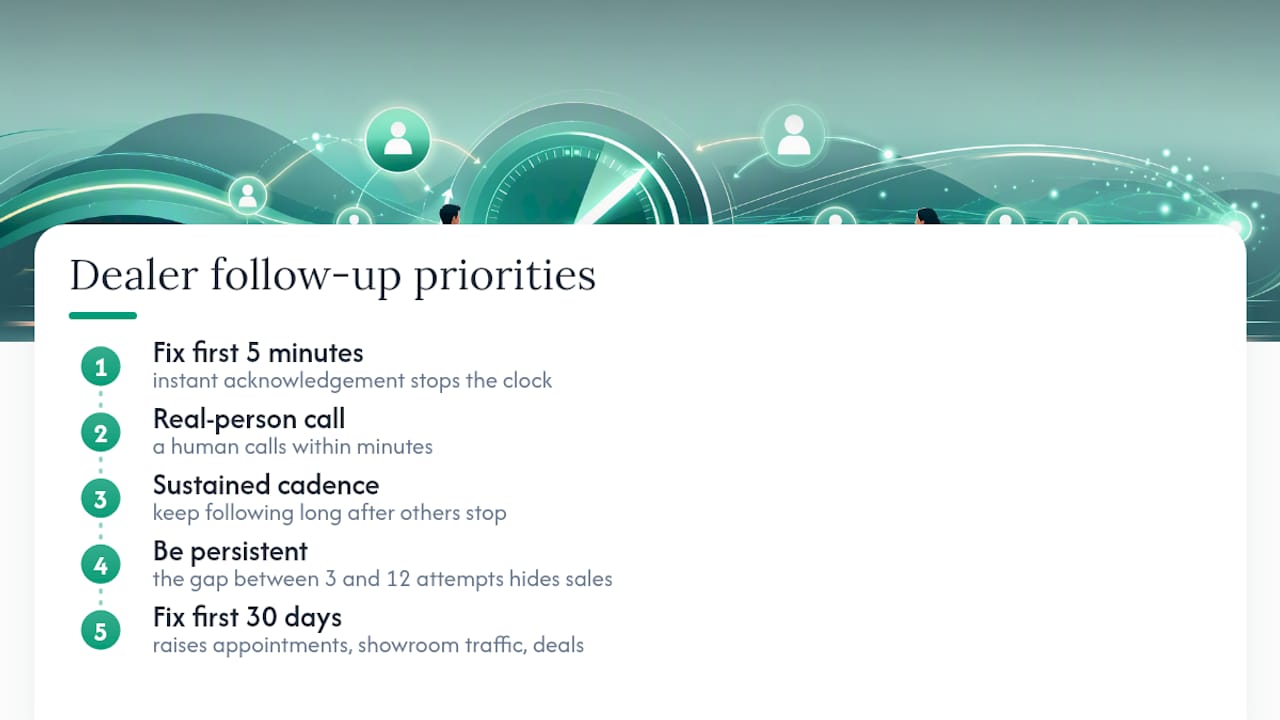
Where most dealers get it wrong is treating automation and personal contact as a choice between the two. The strongest performers use both: an instant acknowledgement to stop the clock, then a real person calling within minutes, then a cadence that keeps going long after most teams have quietly stopped trying. If you take one thing from this article, it should be persistence, since the gap between three attempts and twelve is where most of the lost sales actually live.
Fix your first five minutes and your first thirty days before you touch anything else. Everything downstream, appointment rates, showroom traffic, closed deals, moves in response to those two numbers more than any other lever a dealership has.
— ibrahim
Get your dealership set up to respond faster on Ecosteer
There are platforms that offer Irish dealers a lead inbox designed to support speed and persistence in responses, so the five-minute reply isn’t something you have to build from scratch with spreadsheets and personal mobiles.
Rather than juggling marketplace notifications, email, and text across separate apps, some platforms allow dealers to manage enquiries, buyer messages, and vehicle listings from one place, with free listing tools for lower-value vehicles providing a low-risk starting point for dealers who haven’t tried an Irish-focused marketplace before. Pair Ecosteer’s lead tools with the operational fixes covered here, accurate stock data, fast acknowledgements, a real cadence, and speed stops being a one-off effort and becomes routine. Head to Ecosteer to list your current stock and start managing leads through a single inbox, or check out dealer listings across Ireland to see how other dealerships present themselves on the platform.
Sources
For deeper detail, see the multi-touch follow-up guide, the lead response time study, and Leadresponsemanagement.
- Lead Response Time Optimization: Why the First 5 Minutes Determine Your Close Rate - 2026 Guide
- flai is the latest startup bringing AI to car dealerships — TechCrunch
Recommended
Ecosteer Editorial
Author