Car Buying Tips
Private Sale vs Dealer in Ireland: Which is Best for Your Next Car?
A clear, practical guide comparing private car sales and dealer purchases in Ireland. Learn the legal protections, risks, red flags, and smart buying steps to ensure your next vehicle is a safe and reliable investment.
Primary Admin
8 min read
130 views
You spot a 2022 electric vehicle listed privately for €5,000 less than the local forecourt price, and for a moment, it feels like you've won the lottery. However, that initial saving can quickly vanish if you discover the battery is degraded or the car has a hidden history of accident damage. Deciding between a private sale vs dealer Ireland is the most critical choice you'll make before signing a logbook.
It's completely natural to feel stressed about being outmanoeuvred by a professional salesperson or, worse, being misled by a stranger on the side of the road. We understand that you want the best value for your money without the constant worry of buying a mechanical nightmare that ends up costing thousands in repairs.
This article provides the clarity you need to move through the Irish used car market with total confidence. You'll learn how the Consumer Rights Act 2022 protects your purchase at a dealership, why the principle of "caveat emptor" makes private sales a legal minefield, and exactly which documents you need to check to ensure your next car is a reliable investment rather than a costly burden.
Key Takeaways
Understand how the Consumer Rights Act 2022 provides a legal safety net at a dealership that simply does not exist in the private market.
Evaluate the financial trade-offs of a private sale vs dealer Ireland to determine if a lower price outweighs the lack of a statutory warranty.
Learn the specific red flags for spotting "disguised traders" who pose as private sellers to evade their legal responsibilities to Irish consumers.
Identify the essential paperwork and history checks, including mileage verification and outstanding finance, required to avoid buying a crashed or clocked vehicle.
Discover which buying route best aligns with your mechanical knowledge and risk tolerance to ensure your next car is a safe, reliable investment.
The Core Legal Distinction: Consumer Rights vs Caveat Emptor
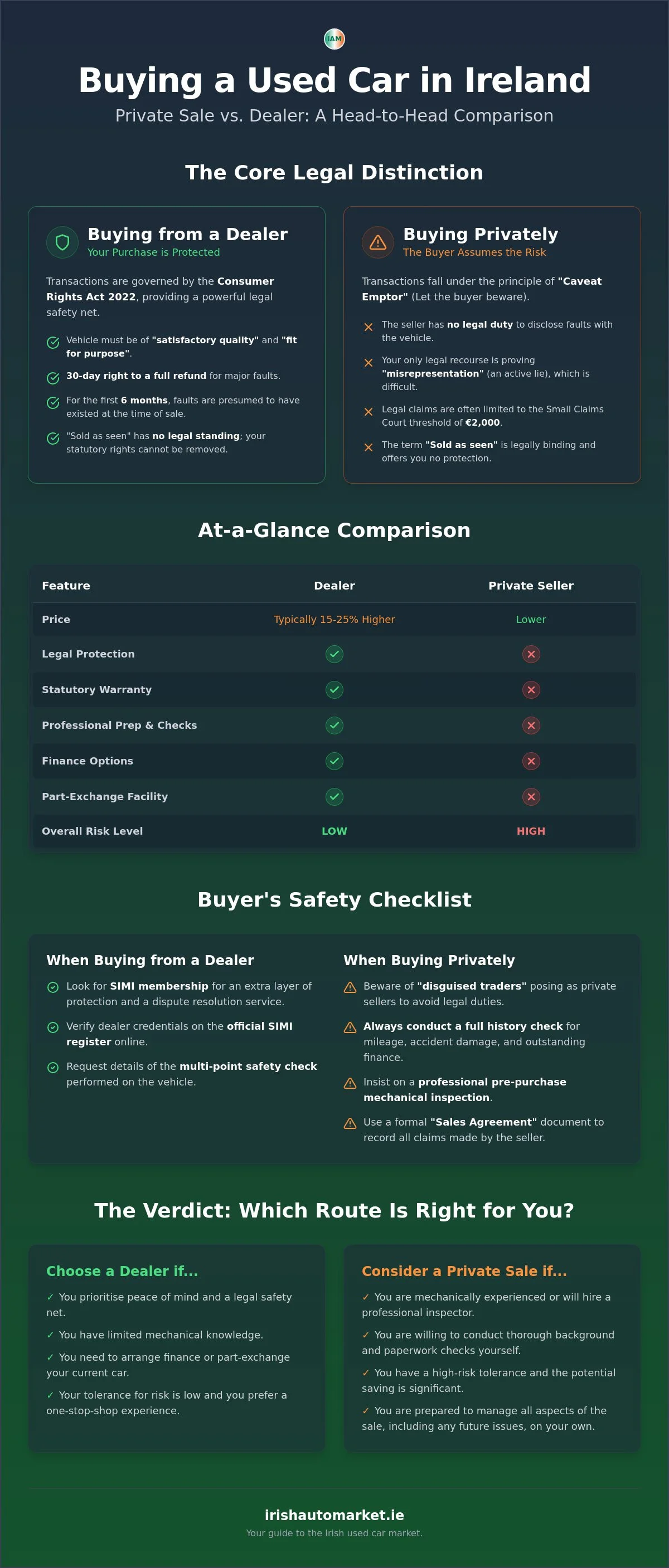
When you weigh up a private sale vs dealer Ireland, the most significant difference isn't the price tag; it's the legal safety net beneath your feet. Choosing a registered motor trader means you're entering a contract protected by the Consumer Rights Act 2022. This legislation is designed to ensure you aren't left stranded with a mechanical failure shortly after leaving the forecourt. Conversely, private transactions operate under the ancient legal principle of Caveat Emptor, or "let the buyer beware."
In a private sale, the seller has no legal obligation to volunteer information about the car's faults. Unless you specifically ask a question and they provide a false answer, they can remain silent about a failing clutch or a leaky head gasket. You might see the phrase "sold as seen" scrawled on a private receipt. While this holds weight in a private deal, it has absolutely no legal standing when buying from a registered dealer. A professional trader cannot contract out of your statutory rights, regardless of what's written on the invoice.
What the Consumer Rights Act 2022 means for you
The 2022 Act is a powerful tool for Irish motorists. It mandates that any vehicle sold by a dealer must be of "satisfactory quality" and "fit for purpose." This doesn't mean a ten-year-old car must be perfect, but it must be roadworthy and durable enough for its age and mileage. If a major fault appears within the first 30 days, you have a short-term right to reject the car and demand a full refund. Beyond this window, the law simplifies your path to a remedy. For the first six months, any defect is presumed to have existed at the time of delivery, meaning the burden of proof rests on the dealer to prove the car was sound when they sold it.
The reality of private sales: Your limited safety net
Buying from a private individual is a different story altogether. Your only real legal recourse is proving "misrepresentation." This means you must show the seller actively lied about a specific detail, such as the car's service history or accident status. Proving this in the Small Claims Court is notoriously difficult and time-consuming. Because the court's jurisdiction for consumer claims is generally limited to €2,000, many car-related disputes quickly exceed this threshold, forcing you into more expensive legal territory. To protect yourself, always use a formal "Sales Agreement" document. This should clearly state the agreed price, date, and any specific claims the seller has made about the vehicle's condition.
Buying from a Dealer: The Premium for Peace of Mind
Choosing a dealership usually means paying a higher price for your vehicle. For a typical family hatchback, you should expect to pay between 15% and 25% more than you would in a private transaction. This markup isn't just profit. It covers the cost of professional mechanical preparation, a deep valet, and the statutory protections discussed earlier. When evaluating a private sale vs dealer Ireland, remember that this premium buys you an advocate if things go wrong. Dealers invest in their stock to protect their reputation, which often means you're getting a car that has already passed a multi-point safety check.
If you aren't a mechanical expert, this preparation is invaluable. A dealer will typically address minor issues, like worn brake pads or a due service, before the car hits the forecourt. You can use Ecosteer’s Used Car Search Tool to see how these dealer prices compare to the wider market for specific makes and models. It allows you to gauge whether the peace of mind offered is worth the extra investment for your specific budget.
SIMI Membership and what it signifies
Look for the SIMI logo on the showroom window. The Society of the Irish Motor Industry (SIMI) is the national trade representative body. Members must adhere to a strict code of ethics. If a dispute arises that you can't resolve directly with the trader, SIMI provides an independent dispute resolution service. This acts as a secondary layer of security beyond your legal rights. You can easily verify a dealer's credentials by checking the official SIMI register online to ensure they're legitimate professionals rather than "kerbside" traders posing as established businesses.
Finance and Aftersales: The 'One-Stop Shop' experience
Dealers offer a level of convenience that a private individual cannot match. If you have an existing car, a dealer will likely accept it as a part-exchange. This removes the stress of selling your old vehicle independently. They also facilitate finance through Personal Contract Plans (PCP) or Hire Purchase (HP) agreements, often with quick approval times. According to official advice on buying a used car in Ireland, these financial options are a primary draw for many buyers. Just be sure to distinguish between a 'Manufacturer Approved' warranty and a basic third-party warranty. The former usually offers much broader coverage for parts and labour in 2026, providing a genuine safety net for your investment.
Buying Privately: Maximising Value whilst Managing Risk
For many buyers, the primary motivation for choosing a private seller is the potential for significant savings. By cutting out the dealer's margin, you often find the same make and model for €2,000 to €4,000 less than a forecourt price. This represents the "true" market value, stripped of showroom overheads and commission. When you compare a private sale vs dealer Ireland, the private route is also frequently the only way to source enthusiast vehicles or older, well-maintained models that dealerships typically send to auction rather than retail.
Beyond the price, meeting the previous owner provides invaluable context that a dealership cannot offer. You get to see the environment where the car was kept. A tidy driveway and a seller who can produce a folder full of receipts suggest a level of care that a shiny valet might hide. Use this opportunity to gauge their driving behaviour; a person who speaks knowledgeably about oil changes and tyre brands is usually a safer bet than someone who can't remember when the car was last serviced.
How to vet a private seller before you travel
Your vetting process should start long before you meet in person. Ask specific questions over the phone to filter out time-wasters or "kerbside" traders. Ask if the seller's name and address match the Vehicle Licensing Certificate (VLC) exactly. If they hesitate or claim they're selling it for a cousin, it's a major red flag. A transparent seller will be happy to provide the car's registration number so you can perform your own history checks. If the "vibe" feels off or they're pushy about a quick sale, trust your instincts and walk away.
Negotiating the best price in a private deal
Preparation is your best weapon during negotiations. Use Ecosteer’s Used Car Search Tool to gather data on comparable listings across Ireland. Having a firm grasp of current market prices prevents you from overpaying. If your inspection reveals mechanical flaws, such as worn tyres or a looming NCT date, use these as leverage to lower the price. Be realistic; don't expect a discount for minor age-related wear, but do negotiate hard for genuine repairs. Finally, prioritise safety during the transaction. Whilst cash was once the standard, a real-time bank transfer is now the preferred method for most, as it provides a digital paper trail for both parties.
Ecosteer.ie
Your Trusted Source for Irish Motoring Advice
Tags
private sale vs dealer irelandused car buying irelandecosteer car guideconsumer rights act 2022 irelandcaveat emptor irelandbuying from dealer irelandbuying privately irelanddisguised traders irelandused car legal rights irelandsimi dealer irelandused car checklist irelandused car history check irelandmileage verification irelandoutstanding finance check irelandprivate seller red flags irelandused car negotiation tips irelandused car market ireland 2026
PA
Primary Admin
Author