€120–€2,400: Motor tax bands in Ireland 2026 and how to check
Find Ireland's 2026 motor tax bands, from the €120 EV flat rate to €2,400 for high-CO₂ cars. See which system applies and check your exact rate online...
Which motor tax band applies to your car comes down to one date: when it was first registered. Cars registered from 1 January 2021 fall under WLTP CO₂ bands, ranging from €120 a year for a fully electric car to €2,400 for the highest emitters. Older cars sit under NEDC or engine-cc rules. Budget 2026 left every rate unchanged, so the tables in force since January 2021 still apply.
TL;DR:
- Cars registered from January 2021 are taxed based on WLTP CO₂ bands, ranging from €120 for electric vehicles to €2,400 for high emitters.
- Older cars between July 2008 and December 2020 are taxed on NEDC CO₂ bands, with rates from €120 to around €2,400 depending on the band.
- Electric vehicles pay a flat €120 annually, while plug-in hybrids are taxed on actual CO₂ emissions, which may place them in mid-range bands.
- Paying motor tax annually typically costs less overall than half-year or quarterly payments, which include surcharges, saving around €40 to €55 per year.
Table of Contents
- Current motor tax rates Ireland: WLTP, NEDC and engine-cc bands
- Which tax system and band actually applies to your car?
- How to check your exact motor tax rate online
- Payment periods: why paying annually usually costs less
- Exemptions, EVs, PHEVs and commercial rates
- Practical tips for buyers comparing motor tax before purchase
- A buyer’s take on motor tax bands
- Estimate your motor tax before you buy, not after
- Sources
Current motor tax rates Ireland: WLTP, NEDC and engine-cc bands
Three separate systems run side by side, and which one taxes your car depends entirely on its first registration date, not the model year printed on the brochure. The Department of Transport’s rate tables confirm this three-tier structure and set the annual figures every local authority uses.
Cars first registered from 1 January 2021 fall under WLTP (Worldwide Harmonised Light Vehicle Test Procedure) CO₂ bands. This is the current benchmark, and it’s the one most buyers researching motor tax bands in Ireland actually need.
Cars registered between 1 July 2008 and 31 December 2020 are taxed on NEDC (New European Driving Cycle) CO₂ bands, labelled A0 through G. These run from roughly €120 for the lowest band up to around €2,400 for Band G, with the mid-range bands most commonly seen on family diesels and petrols from that era.
Anything registered before 1 July 2008 is taxed purely on engine size. Rates climb from around €199 a year for engines under 1,000cc to well over €1,800 for anything above 3,000cc, regardless of how efficient the engine actually is. The full figures for every band, across all three systems, sit in the Department’s 2021 rates document, which remains the definitive reference.
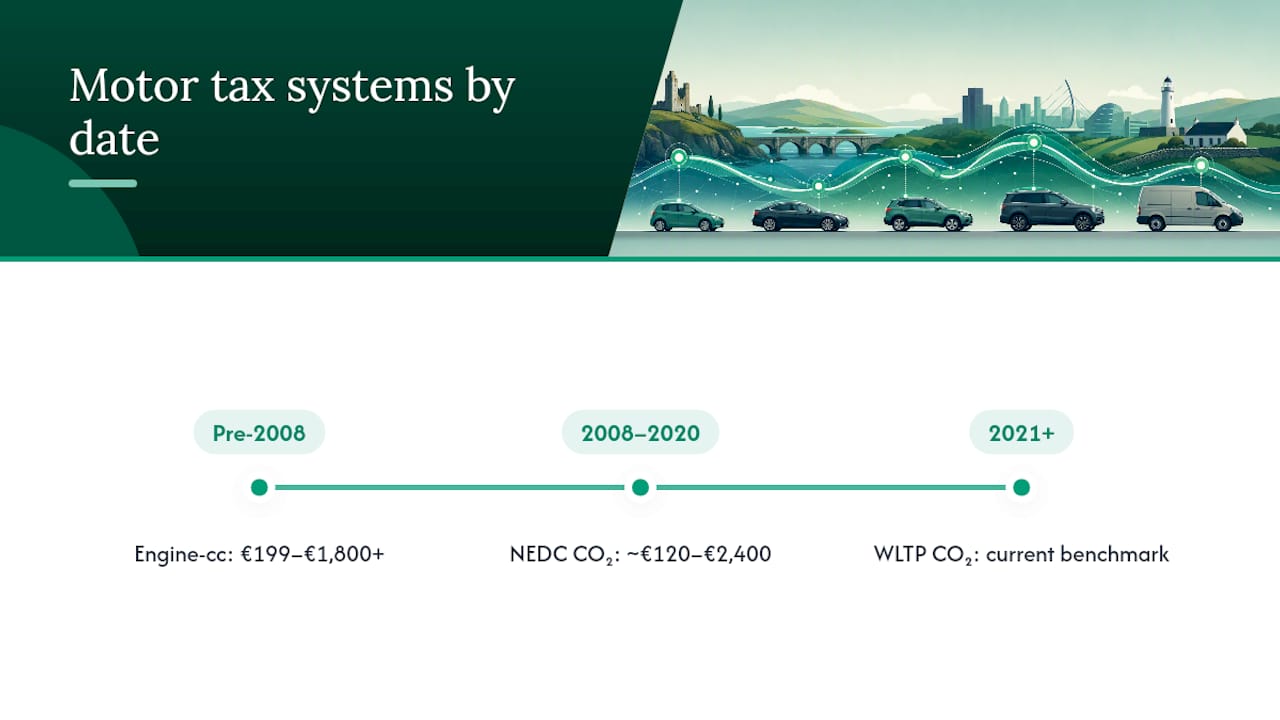
Every band can be paid annually, half-yearly, or quarterly.
Which tax system and band actually applies to your car?
Your car’s date of first registration decides everything, not the badge on the boot or the year the model launched. A 2021 model sold in late 2020 could still sit under NEDC rules, while a facelifted version registered weeks later falls under WLTP.
To find your figures:
- Check the Vehicle Registration Certificate (VRC) for the CO₂ emissions figure or engine capacity.
- Cross-reference the registration date against the three regime cut-offs (pre-July 2008, July 2008 to December 2020, or January 2021 onward).
- For newer cars, confirm whether the spec sheet quotes a WLTP or NEDC figure, since WLTP testing tends to produce higher CO₂ numbers than NEDC for the same underlying engine.
- If the car is a plug-in hybrid, don’t assume it qualifies for the electric vehicle flat rate. PHEVs are taxed on their actual CO₂ figure, which can still land them in a mid-range band.
How to check your exact motor tax rate online
The fastest route is the official Motortax, which returns your car’s current rate the moment you enter its registration number.
- Go to motortax.ie and select the vehicle lookup tool.
- Enter your registration number exactly as it appears on the VRC.
- Review the rate returned, checking it against the renewal notice you’ve received by post.
- Have your VRC PIN, current insurance details, and NCT certificate (where applicable) ready before starting an online renewal.
- If the lookup fails or the office is more convenient, your local motor tax office can process the same renewal by post or in person.
Pro Tip: If you’ve just bought a used car, re-run the lookup after the ownership transfer completes. A change of tax class on transfer can alter the rate immediately, and the figure on the old owner’s disc may no longer be correct.
Payment periods: why paying annually usually costs less
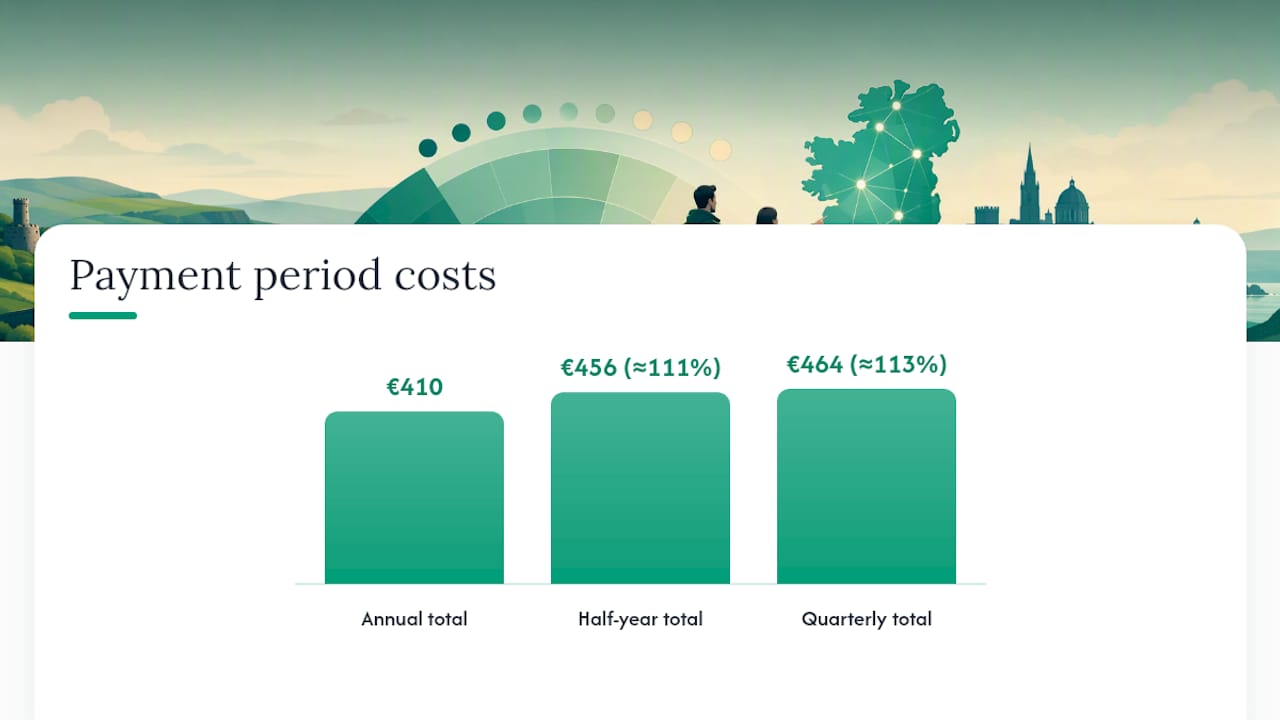
Motor tax can be paid annually, half-yearly, or quarterly, and each shorter period carries a built-in surcharge. Half-year payments work out at roughly 111% of the annual rate when doubled, and quarterly payments at around 113%, according to independent cost breakdowns.
For a car taxed at €410 a year:
- Annual: €410 in one payment.
- Half-year: two payments of roughly €228, totalling around €456.
- Quarterly: four payments of roughly €116, totalling around €464.
That’s a saving of €40 to €55 simply by paying once rather than splitting it, a gap that widens further up the CO₂ bands. Renewing late also risks a fine and potential Garda attention on the road, so it’s worth setting a reminder well before the disc expires rather than risking a lapse.
Exemptions, EVs, PHEVs and commercial rates
Not every vehicle sits on the standard passenger-car tables. A few categories need separate attention:
- Battery electric vehicles pay a flat €120 a year regardless of which of the three systems would otherwise apply, as confirmed by Citizens Information.
- Plug-in hybrids are taxed on their actual CO₂ figure, not automatically at the EV rate, though older PHEVs registered under NEDC rules sometimes land in a genuinely low band.
- Commercial vehicles are taxed by gross vehicle weight (GVW) rather than CO₂, with reduced rates for heavier goods vehicles used commercially.
- Vintage, veteran, diplomatic, and disability-adapted vehicles may qualify for exemptions or reduced rates. Eligibility varies, so check with your local motor tax office directly.
Practical tips for buyers comparing motor tax before purchase
Before you commit to any car, pull its CO₂ figure or engine size from the VRC or the manufacturer’s spec sheet and run it against the relevant band. This single check can separate a genuine bargain from a car that quietly costs hundreds more a year to keep on the road.
- Always confirm whether a listed spec is WLTP or NEDC, especially for cars registered around the January 2021 cut-off.
- Ask the seller or dealer for the exact registration date if it’s not stated clearly.
- Keep your VRC, insurance certificate, and NCT details together before renewing or taxing a newly bought car.
- Compare running costs, not just the purchase price, when shortlisting between two similar models.
Pro Tip: If you’re weighing an EV against a petrol equivalent, the Kia EV3 buyer’s guide walks through how the €120 flat rate stacks up against a full year of fuel and tax on a comparable combustion model.
A buyer’s take on motor tax bands
Most people shop for a car on price and finance, then get blind sided by the tax disc a year in. Check the CO₂ figure before you fall in love with a listing, not after. Pay annually if you can afford the lump sum, since the saving is real money for no extra effort. And if you’re cross-shopping fuel types, run the numbers through a resource like Ecosteer’s ownership cost breakdown before you decide.
— ibrahim
Estimate your motor tax before you buy, not after
You can filter listings by fuel type and CO₂ figure to compare real annual running costs, not just sticker prices.
Every listing on Ecosteer’s marketplace shows the detail you need to estimate the band a car falls into, whether that’s a low-tax EV or a mid-range petrol you’re cross-shopping against a hybrid. If you’d rather see cost comparisons laid out first, our guide on used cars across fuel types breaks down how tax bands shift the real cost of ownership between diesel, petrol and electric. Once you’ve narrowed your options, find a dealer near you to confirm the exact registration date and CO₂ figure before you commit. Start browsing listings and factor motor tax in from the first search, not the first tax disc.
Sources
- Gov
- Motor taxation: rates effective 1 January 2021 — Department of Transport (PDF)
- Motortax
- Motor tax rates — Citizens Information
Recommended
Ecosteer Editorial
Author