EV Grants in Ireland 2026: How Much You Get and What’s Changing
Ireland's 2026 EV grants explained: the €3,500 SEAI purchase grant, up to €5,000 VRT relief, ICE2EV update, price‑cap changes and where to compare final...
You can currently get up to €3,500 off a new electric car through the SEAI purchase grant, up to €5,000 in VRT relief depending on the vehicle’s price band, and Home Charger support toward a domestic charge point. The ICE2EV scrappage top-up, which once pushed combined support to €8,500, has sold out its funding pot. Your next move: check the SEAI eligible vehicle list or ask an SEAI-approved dealer to confirm which supports still apply to your chosen model.
TL;DR:
- The SEAI purchase grant offers up to €3,500 for eligible new EVs bought through approved dealers, with vehicle price caps subject to change in 2026.
- The ICE2EV scrappage scheme, which combined with the grant could reach €8,500, has sold out its funding, so new applications are not accepted at this time.
- Only new, SEAI-registered EVs under the current price cap qualify, and dealer submission of the grant application is automatic once the vehicle and buyer details are verified.
- Charging grants for home chargers and VRT relief can be claimed alongside the purchase support, but timing and eligibility must be carefully managed.
- Fast-moving deadlines and scheme caps require early dealer confirmation, written proof of the Letter of Offer, and prompt payment requests to secure the maximum support.
Table of Contents
- What is the SEAI electric vehicle purchase grant?
- What happened to the ICE2EV scrappage scheme?
- Which vehicles actually qualify for support?
- How do you apply through a dealer?
- What charging grants can you claim alongside a new EV?
- What grants exist for businesses, fleets and taxis?
- How does VRT relief work with these grants?
- What’s changing in 2026 and how fast do you need to move?
- Ecosteer’s take: finding SEAI-approved dealers without the guesswork
- Is now a good time to buy an EV in Ireland?
- Compare grant-adjusted EV prices before you commit
- Sources
- FAQ
What is the SEAI electric vehicle purchase grant?
The Sustainable Energy Authority of Ireland (SEAI) runs the main purchase grant for new battery electric vehicles (BEVs), and it’s the support most buyers mean when they search for ev grants ireland. Dealers apply it directly, so you never handle the paperwork yourself. The amount comes straight off the vehicle’s list price before you sign anything.
Grant snapshot: Private buyers of eligible new BEVs can receive a purchase grant of €3,500, according to Citizens Information. Vans and larger vehicle categories can qualify for different amounts under separate SEAI provisions.
A few mechanics decide whether you’ll see that full amount at the till:
- The vehicle must sit under SEAI’s list-price cap to qualify at all, and 2026 brings a change to that threshold worth checking before you order.
- Only new vehicles bought through an SEAI-approved dealer or importer qualify. Private imports and used EVs are excluded from this particular grant.
- The dealer submits a Letter of Offer on your behalf once your order is confirmed, and that offer has a validity window you need to respect.
- The grant is deducted from the list price at the point of sale, so the figure you see advertised should already be the reduced price, not something you claim back later.
Ask your dealer to show you the grant applied on the invoice, not just quoted verbally. If the paperwork isn’t SEAI-registered, the discount you’re expecting simply won’t materialise.
What happened to the ICE2EV scrappage scheme?
The ICE2EV pilot paid €5,000 to drivers who scrapped an old petrol or diesel car and switched to an eligible EV, funded from a €10 million pot announced by the Department of Transport. Combined with the standard SEAI purchase grant, that meant some buyers could access total support of €8,500 toward one new car.
Eligibility rested on a handful of firm rules:
- The scrapped vehicle had to meet minimum registration age and history requirements set by the pilot’s terms.
- Funding was split across rural and urban allocations, meaning your region’s pot could close before the national total did.
- Payments were first-come, first-served, and the scheme’s allocation sold out during 2026.
If you missed the window, you’re not necessarily out of luck long-term. The government has signalled interest in further Zero Emission Vehicles Ireland (ZEVI) measures, and any fresh scrappage round would likely follow the same rural/urban split and the same fast-exhaustion pattern. Treat scrappage funding as a bonus to watch for, not something to bank on when budgeting your purchase.
Which vehicles actually qualify for support?
SEAI’s own scheme guidelines set out technical and commercial criteria that decide whether an importer can even nominate a model for grant support. Before you fall in love with a specific trim level, run through this checklist:
- Vehicle class and classification – the car must be classified correctly as a battery electric vehicle, meeting minimum speed and range endurance standards set in the T&Cs.
- Warranty minimums – manufacturers must offer warranty cover that meets SEAI’s floor requirements; some grey-import or parallel-import models fall short here.
- Price cap compliance – the vehicle’s list price, including most factory-fitted options, must sit at or below the current cap. Optional extras added after the cap calculation can sometimes push a car over the line.
- New-vehicle status – only brand-new registrations qualify; demonstrator and pre-registered fleet vehicles are treated differently and sometimes excluded entirely.
- Importer approval – the specific importer selling you the car must be registered with SEAI for that model line, not just generally approved as a dealer.
Demo cars and fleet-return vehicles are the most common trap. A dealer might sell you a lightly used demonstrator at a tempting price, but if it’s not classed as new for grant purposes, that €3,500 simply won’t apply. Always ask the specific question: “Is this exact car SEAI-grant eligible, not just this model generally?”
How do you apply through a dealer?
You don’t apply for the SEAI grant yourself in the way you’d apply for, say, a college grant. The ZEVI step-by-step guide confirms the dealer or importer handles the entire submission through SEAI’s online EV Grant System, and approval is typically automatic once the vehicle and buyer details check out against the eligibility rules.
Here’s what to expect and watch for:
- Your dealer submits your order details into the online system, which checks the vehicle against price caps and technical criteria automatically.
- Once approved, SEAI issues a Letter of Offer, and this has a validity window: the lesser of four months from issue or 31 December of the year it was approved.
- If the dealer’s payment request lands after that window closes, the grant application is rejected outright, even if your order was placed in good faith earlier.
- You’ll need to confirm your own identity and registration documentation, which the dealer collects at order stage.
Pro Tip: Ask your dealer directly, “When was this Letter of Offer issued, and when does the payment request need to go in?” A dealer juggling a busy order book near year-end is the most common reason grants get missed on otherwise straightforward sales.
What charging grants can you claim alongside a new EV?
Buying the car is only half the cost picture. SEAI’s Home Charger Grant Scheme contributes toward installing a domestic charge point, and Citizens Information confirms this sits alongside the purchase grant rather than replacing it. If you live in an apartment or a shared development, separate mechanisms apply:
- The EV Apartment Charging Grant supports management companies and owners’ management committees, not individual apartment owners applying alone.
- A newer shared charging pilot aims to help neighbourhoods or apartment blocks without private driveways access charging infrastructure collectively rather than one household at a time.
- Installation lead times for home chargers can run several weeks, so book your electrician before your car arrives, not after.
If you’re ordering a new EV with a typical dealer lead time of a few months, start your charger application in parallel. Arriving home with a new car and no way to charge it overnight defeats the purpose of the whole exercise.
What grants exist for businesses, fleets and taxis?
Commercial buyers have their own support routes, run partly through the National Transport Authority (NTA) rather than SEAI alone. The electric Small Public Service Vehicle (eSPSV) scheme gives taxi and hackney drivers meaningful support toward switching, and the NTA’s 2026 scheme page confirms wheelchair-accessible vehicle grants can reach up to €25,000, with other amounts set for standard replacement vehicles.
- eSPSV grants cover taxis, hackneys and limousines switching to electric, with higher support for wheelchair-accessible models.
- ZEHDV (Zero Emission Heavy Duty Vehicle) support offers a percentage of the price difference between an electric and diesel equivalent, up to a set maximum.
- Businesses applying to multiple schemes must track cumulative support against the EU state aid de minimis ceiling of €300,000 over a rolling three-year period.
If your business has already claimed SEAI or NTA support this year, add up every grant received before applying again. Exceeding the ceiling isn’t a paperwork inconvenience; it can void the aid entirely.
How does VRT relief work with these grants?
Vehicle Registration Tax (VRT) relief is separate from the SEAI purchase grant but stacks with it at registration. Revenue’s guidance confirms relief of up to €5,000 applies to eligible electric vehicles, scaled against Open Market Selling Price (OMSP) bands running up to €50,000.
- VRT relief is applied automatically when the vehicle is registered; you don’t submit a separate claim.
- The relief reduces the out-the-door price you actually pay, on top of whatever the SEAI grant has already knocked off.
- Certain reliefs are time-limited, with some provisions running through 31 December 2026, so a car registered in January 2027 could face different VRT treatment.
- Higher-priced EVs near the top of the OMSP band see proportionally less relief, so the two supports don’t scale identically as price rises.
What’s changing in 2026 and how fast do you need to move?
Funding caps and price-cap thresholds move faster than most buyers expect. The ICE2EV scrappage pot, backed by a €10 million allocation, sold out well before many potential applicants even knew it existed.
- Vehicles with list prices under the current SEAI cap qualify for the standard grant; that cap rises to €50,000 for applications received after 31 July 2026, opening the grant to pricier models from that date.
- First-come-first-served funding means popular models near a price-cap edge attract a rush of orders as deadlines approach.
- Before ordering, confirm your dealer’s SEAI registration, gather your identity documents early, and ask for written confirmation the Letter of Offer will be submitted promptly.
- Check live scheme status directly on SEAI’s grant pages or the gov.ie ZEVI campaign before signing an order, since press coverage often lags behind actual fund closures.
Ecosteer’s take: finding SEAI-approved dealers without the guesswork
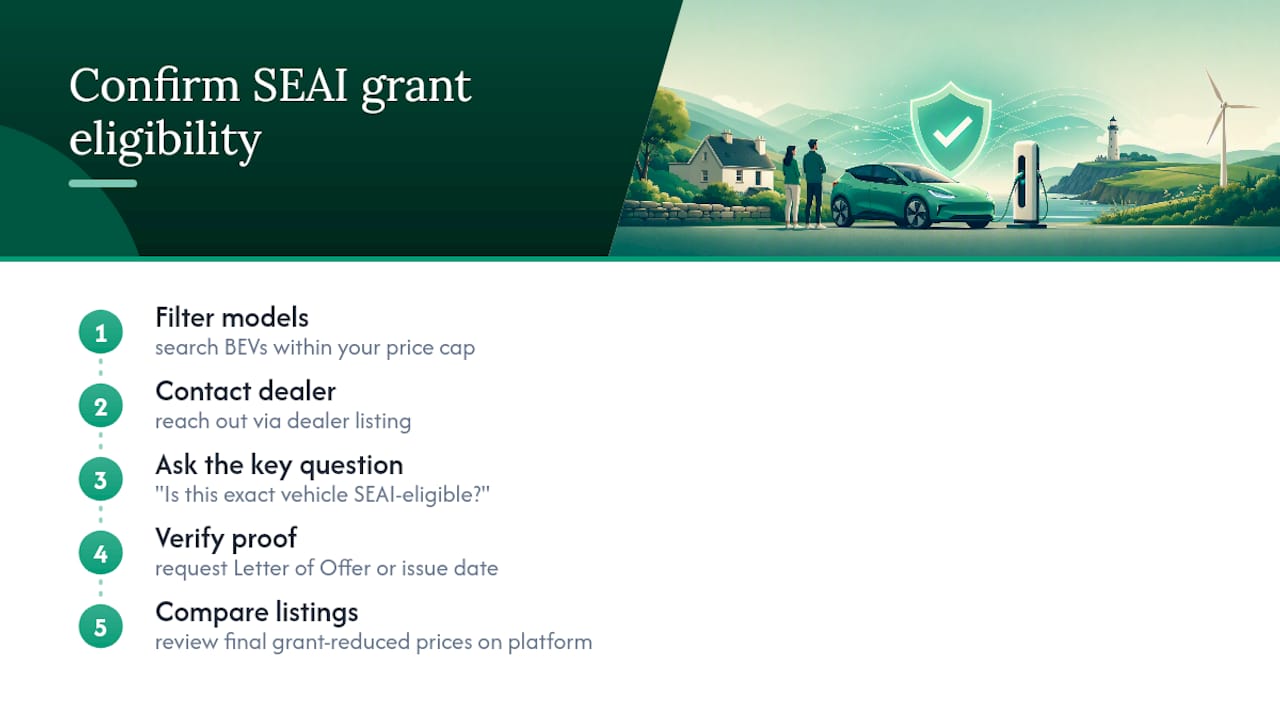
Ecosteer’s dealer finder and model filters let you search specifically for new BEVs within your price cap, then contact dealers directly to ask the one question that matters: is this exact vehicle SEAI-grant eligible? Before you commit, ask the dealer to show you the Letter of Offer or confirm its issue date. Comparing final, grant-reduced prices across several listings on one platform beats phoning around dealerships individually.
Is now a good time to buy an EV in Ireland?
Buying now makes sense if your chosen model sits comfortably under the current price cap and your dealer can confirm grant paperwork quickly. Waiting only pays off if you’re hoping for a renewed scrappage round, and that’s a gamble given how fast the last pot closed. Businesses need to check their de minimis headroom before every application, not just the first one. My practical checklist: confirm dealer SEAI registration, get the Letter of Offer date in writing, and don’t sign until the invoice shows the grant already deducted.
— ibrahim
Compare grant-adjusted EV prices before you commit
Working out which dealer genuinely passes on the full SEAI grant, versus one who’s quietly padded the list price beforehand, takes real digging if you’re calling around individually. Ecosteer solves that by letting you filter new BEV listings by price, county and model in one search, then message SEAI-approved dealers directly to confirm their Letter of Offer status before you travel to view anything.
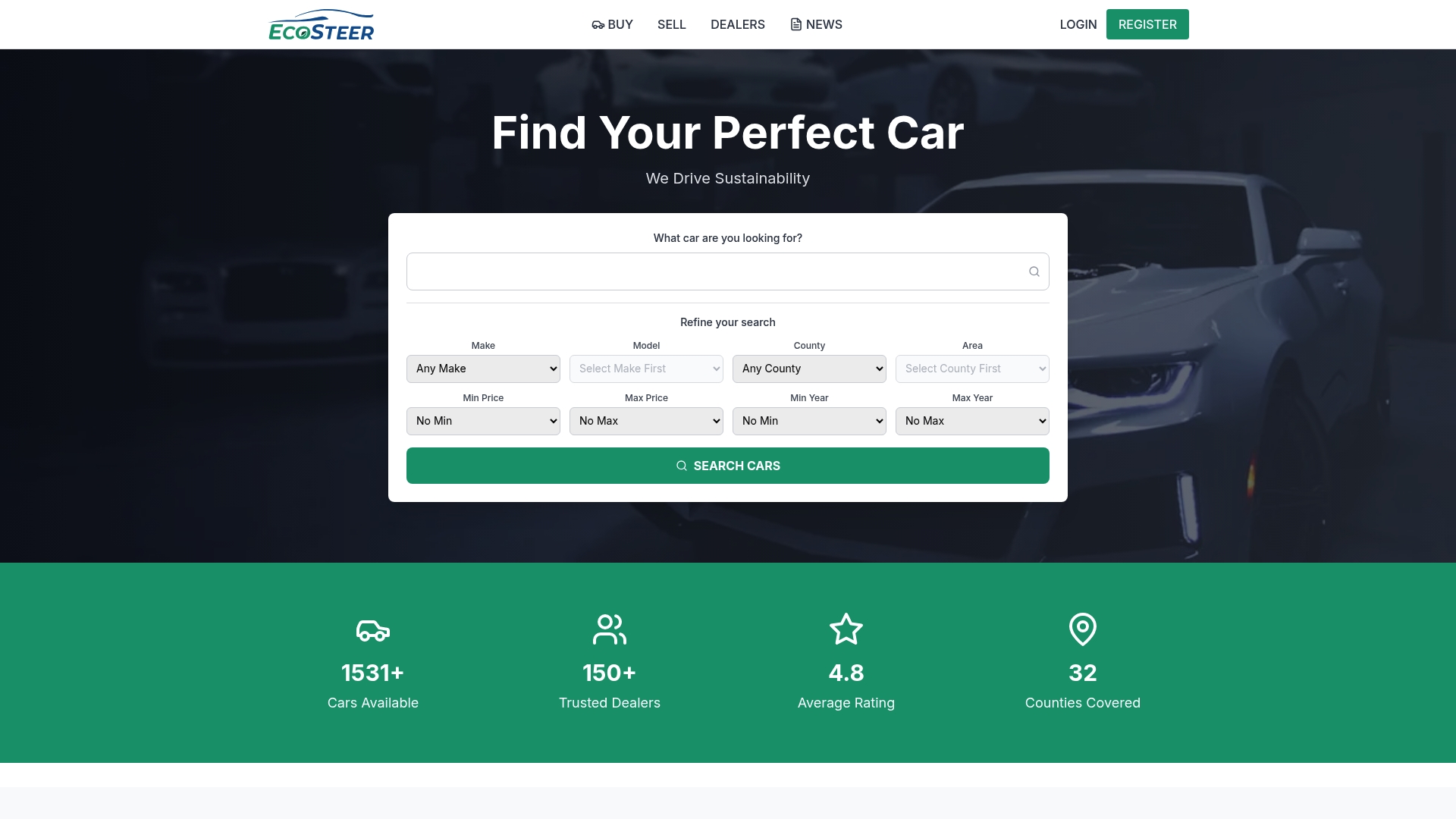
Every listing shows the asking price so you can compare grant-reduced totals side by side rather than guessing which quote already includes the €3,500 SEAI deduction. If you’re also weighing VRT relief bands or want a broader sense of what’s on the market, Ecosteer’s used and new EV comparison guide is worth a read alongside your search. Start browsing eligible models on Ecosteer’s marketplace and shortlist dealers before your next test drive.
Sources
Scheme terms shift during the year, so bookmark the primary sources rather than relying on secondhand summaries:
- Electric vehicle grants | SEAI
- Minister announces €10 million funding for ICE2EV scheme
- Electric vehicles | Citizens Information
- Electric vehicles: calculating VRT | Revenue
Check the publication date on any page before applying. Scheme caps, funding pots and closing dates change during the year, and a guide written in early 2026 may not reflect a cap adjustment introduced later.
FAQ
Who is eligible for the SEAI EV grant?
Private buyers purchasing a new, SEAI-approved battery electric vehicle under the current price cap through an approved dealer are eligible for up to €3,500, per Citizens Information. Used imports and non-approved models don’t qualify.
What is the ICE2EV scrappage grant and is it still available?
ICE2EV paid €5,000 to drivers scrapping an old petrol or diesel car for an eligible EV, funded from a €10 million pot that has since sold out. Combined with the SEAI grant it could reach €8,500, but new applications aren’t currently being accepted under that specific pilot.
What are the requirements for the 2026 EV grant scheme?
You need a new BEV under the SEAI price cap, bought through an SEAI-approved dealer, with the cap rising to €50,000 for applications received after 31 July 2026. The dealer submits your Letter of Offer, which must be paid within its validity window to secure the grant.
Does VRT relief affect how much I pay after the SEAI grant?
Yes. VRT relief of up to €5,000 applies separately at registration, based on the vehicle’s OMSP band, and stacks with the SEAI purchase grant deducted at sale, per Revenue’s guidance.
How long does it take to get the grant applied?
The dealer typically submits your application through SEAI’s online system at order stage, with approval usually automatic once eligibility checks pass. Payment must be requested within the Letter of Offer’s validity window, generally four months or by 31 December of the approval year, whichever comes first.
Recommended
Ecosteer Editorial
Author