For Sellers: Car negotiation scripts, staged concessions and deposits
Practical car negotiation tips for sellers: ready scripts, staged concession rules and deposit templates to help you hold your asking price.

The most effective negotiation stance for sellers is a confident, data-backed anchor combined with concession discipline and a genuine willingness to walk away. Set your price using pricing guides and recent local sales, back it up with vehicle history documentation, and let smaller, diminishing concessions do the persuading. Sellers who improvise lose money; sellers who script their responses and hold their floor rarely do.
TL;DR:
- Setting a confident, data-backed asking price with a small buffer and clear documentation helps sellers maintain leverage during negotiations.
- Responding to lowball offers with patience, reasoning, and evidence-based counters prevents unnecessary price drops and encourages serious offers.
- Using staged concessions and binding, conditional offers signals limits without revealing them, strengthening bargaining position.
- Listing for a defined time window and scheduling back-to-back showings increases competition and maximizes sale price.
- Keeping all paperwork, deposits, and communications in writing ensures security and clarity in both private and trade-in negotiations.
Table of Contents
- Car negotiation tips: a quick checklist before you take any offers
- How to respond to a lowball offer
- Pricing and anchoring: setting your asking price and floor
- Concession discipline: staged counters and conditional moves
- Creating competition: timed offers and showings
- Paperwork, deposits and payment verification
- Safety and test-drive protocol
- Closing techniques and trial closes
- Strategies for negotiating trade-ins
- Understanding buyer psychology and common negotiation tactics
- Effective communication skills during negotiation
- Handling emotions and staying calm
- Timing considerations for selling
- Author perspective: applying these tactics inside a real workflow
- List, manage and close with Ecosteer
- Sources
Car negotiation tips: a quick checklist before you take any offers
Before you answer a single message, get these six things sorted. Rushing into a negotiation without preparation is the fastest way to leave money on the table.
-
Set your asking price, floor and buffer using at least two pricing sources, so you know exactly how far you can move.
-
Gather vehicle history, service records and a VIN report before listing, not after a buyer asks.
-
Decide your deposit policy and have a receipt template ready to fill in on the spot.
-
Plan where you’ll meet buyers and how test drives will work so you’re not improvising with a stranger in your driveway.
-
Decide whether you’re accepting offers for a fixed window or negotiating on a rolling basis
-
Write three short scripted responses for common openers, including the lowball offer.
Private buyers often open 5–15% below your asking price, so price slightly above your true minimum to leave room to negotiate without flinching.
How to respond to a lowball offer
A lowball offer is not an insult. It’s a test to see whether you’ll fold. Sellers who ask the buyer how they arrived at their figure and respond with data, rather than emotion, close far closer to their asking price than those who react on instinct.
- Pause before replying. Don’t counter within seconds. A short delay signals you’re not desperate.
- Ask for their reasoning. “Can you walk me through how you got to that number?” This often exposes a weak comparison or a bluff.
- Reframe with evidence. Point to pricing guides and recent local sales rather than arguing the toss on feelings.
- Make a precise, time-limited counteroffer. “Based on three comparable sales in the last month, I can do €12,400 if we can agree today.”
- Follow up once if they walk. A single, low-pressure message a few days later. (“Still interested if the number works for you”) often reopens the door without looking needy.
For private buyers, keep the tone collaborative: “I understand you want a fair deal. Here’s what similar cars have sold for locally.” For trade-style or dealer buyers, lead with numbers first: “My floor is set against wholesale and retail guides. Here’s where that leaves us.”
Pro Tip: Never split the difference on a lowball offer automatically. It trains buyers to open low every time, because it works.
Pricing and anchoring: setting your asking price and floor
Your asking price is your anchor. Every counteroffer the buyer makes gets measured against it, so it needs to be defensible before you post the listing.
- Cross-check multiple pricing references: private-party guides, trade-in valuation tools, and actual recent sales in your county for the same make, model, year and mileage.
- Add a small buffer above your true floor, not a large one. A gap that’s too wide invites buyers to assume you’re desperate; too tight and you have no room to negotiate.
- State your price with confidence and never reveal your floor. “This is priced against three recent local sales” carries more weight than “I might come down a bit.”
- Keep your documentation visible. A printed pricing guide comparison or a service history folder in the glovebox does more convincing than any verbal claim.
Consumer Reports recommends anchoring negotiations to recent transaction prices rather than list prices, and negotiating one thing at a time, price, then trade-in, then any financing extras. That same discipline works just as well from the seller’s side of the table.
Concession discipline: staged counters and conditional moves
Every concession you make should be smaller than the one before it. If your first move is €500, your second should be €300, and your third, if you make one at all, should be €150 or less. This staged pattern signals you’re approaching your real limit, whether or not you say so out loud.
- Never lead with your biggest concession. It tells the buyer there’s plenty more where that came from.
- Make concessions conditional. “I can do €300 off if we sign today and you cover the transfer paperwork” beats a free drop in price.
- Hold the mental frame that you’re willing to walk away. Buyers read hesitation, and sellers who genuinely don’t need the sale negotiate better than those who do.
Pro Tip: Use round concession steps, like the $500 rule, so buyers can’t predict your next move from the pattern of your last one.
Creating competition: timed offers and showings
Accepting offers until a stated date is one of the simplest ways to improve your outcome without pressuring anyone. Tell interested buyers plainly: “I’m collecting offers until Sunday evening and will respond to everyone after that.”
- State the window clearly and honestly so no buyer feels misled or rushed unfairly.
- A two to four week collection period usually concentrates enough interest to generate real competition without dragging the sale out.
- Compare offers on the same basis: price, payment method, and readiness to complete, not just the headline number.
- Schedule showings back to back where possible. Seeing another car buyer arrive as they leave does more to signal demand than any script.
Paperwork, deposits and payment verification
A verbal agreement means nothing once money is involved. Put everything in writing before a single euro changes hands.
- Write a deposit receipt that includes both names, the VIN, the deposit amount, the agreed total price, the closing date, and the conditions under which the deposit is non-refundable.
- Accept only secure payment methods. Verified bank transfers or counted cash are safest; if a cashier’s cheque is offered, confirm it directly with the issuing bank before handing over anything.
- Never release the title, logbook or spare keys until funds have fully cleared, not just “shown as sent.”
- Keep a written record of every offer and contingency, even the ones that fell through. It protects you if a dispute arises later.
Safety and test-drive protocol
Meet buyers in public spaces where possible, and always ride along on test drives. It costs you nothing and removes most of the real risk in private selling.
- Meet in daylight, in a public or well-monitored location, and bring someone along if you can.
- Verify the buyer’s identification before handing over keys for a test drive.
- Never hand over the title, logbook, or your home address until payment has fully cleared.
- Trust your instincts. If a buyer pushes to meet somewhere unusual or rushes the process, it’s fine to say no.
Closing techniques and trial closes
A trial close tells you whether a buyer is genuinely ready before you give away any more margin. Ask a conditional question and listen to the answer: “If I could throw in the winter tyres, would you sign today?” That single sentence tells you more about a buyer’s real position than ten minutes of small talk.
- Frame the final stretch around payment and logistics, not emotion. “How would you like to handle payment, bank transfer or verified cheque?” moves the conversation towards completion.
- Offer small extras conditional on immediate completion, rather than price cuts. A tank of fuel or a spare set of mats costs you less than another €200 off.
- Handle “I need to think about it” without conceding price. Ask what specifically they need to think through. Often it’s a logistics question, not a price objection, and you can answer it directly.
Pro Tip: A buyer who negotiates hard and then goes quiet is usually comparing you against another car, not walking away. A brief, calm follow up within 48 hours often closes the deal.
Strategies for negotiating trade-ins
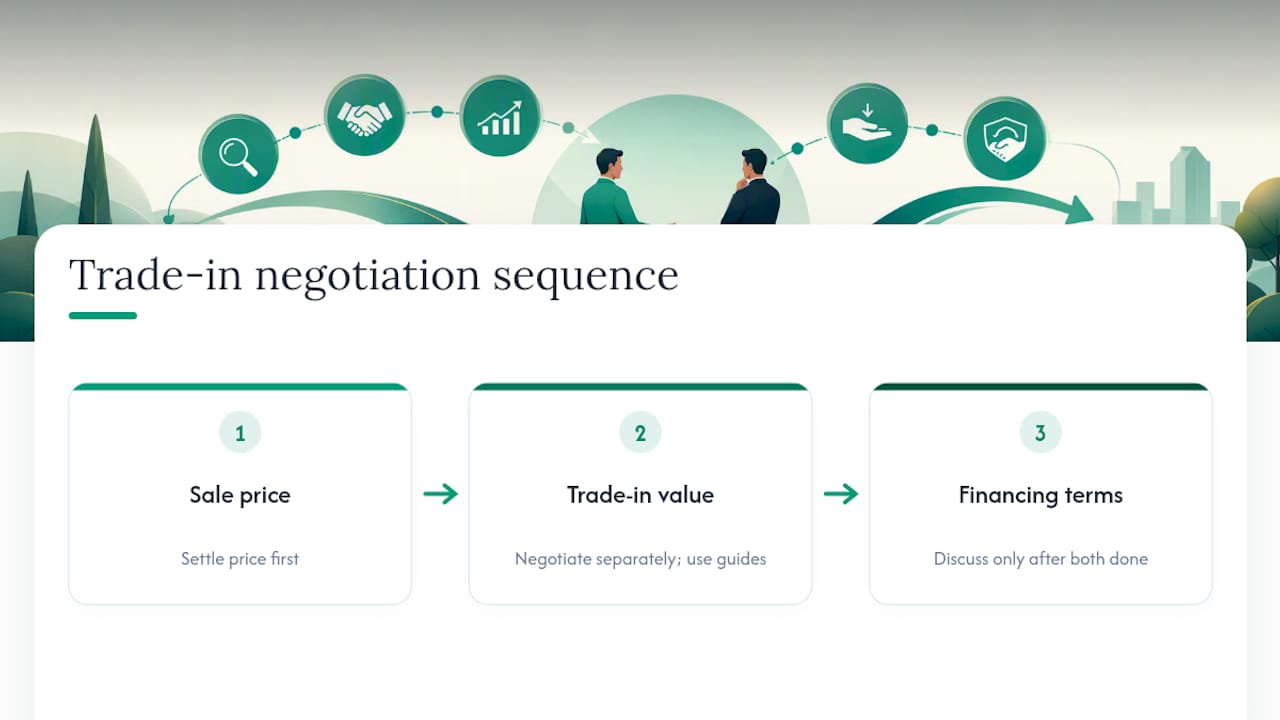
Keep the trade-in conversation entirely separate from the sale price of the car you’re selling, and if you’re a dealer taking in a trade-in as part of a deal, treat it as its own negotiation with its own anchor. Consumer Reports’ advice to negotiate one thing at a time applies just as strongly here: settle the sale price first, then move to the trade-in figure, then any financing terms. Blending the two lets a buyer or a trading customer hide a poor trade-in value inside what looks like a good deal on the main car.
When you’re the one accepting a trade-in against a vehicle you’re selling, value it against the same references you use for your own pricing: private-party and trade valuation guides, plus recent local sales of that specific make and model. Don’t let a customer’s emotional attachment to their old car (a common tactic in itself) inflate the number you offer, and don’t be pressured into a same-day figure. Tell them plainly: “I’ll need to check condition and mileage against current guides before I can confirm a trade value.”
If the numbers don’t work, it’s fine to decline the trade-in altogether and sell the car for cash only. Many private sellers assume they must accept a trade to close a deal. They don’t. Separating the two transactions, and being willing to say no to one while still saying yes to the other, keeps both figures honest and gives you a cleaner paper trail if either side needs to be documented separately later.
Understanding buyer psychology and common negotiation tactics
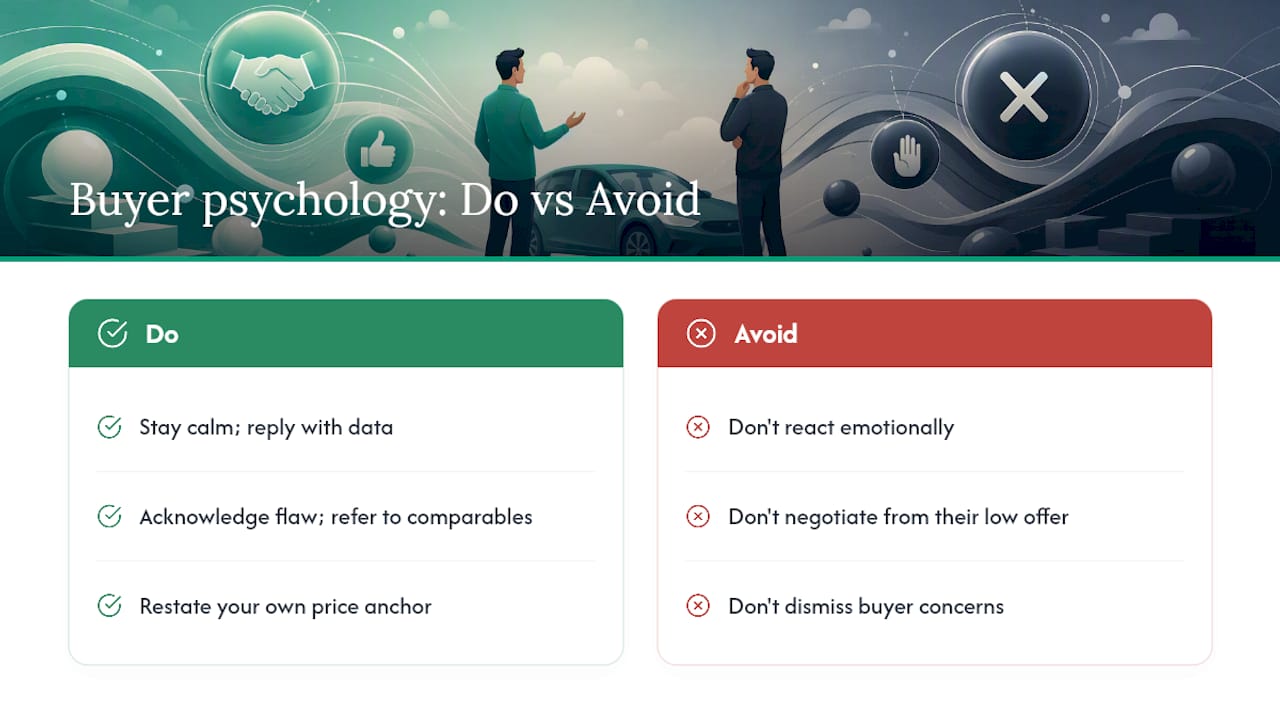
Most buyers open low, not because they think you’ll accept, but to see how you react. A firm, calm, data-backed response ends that tactic within the first exchange. Watch for a handful of recurring moves: the “walking away” bluff, where a buyer pretends to lose interest to pressure a price drop; the “flaw fixation” tactic, where minor cosmetic issues get exaggerated to justify a lowball figure; and the “cash in hand” push, where a buyer waves money to force an immediate, unconsidered decision.
None of these tactics work well against a seller who has already done the preparation covered earlier. A structured, calm, data-backed reply reduces the success of lowball ploys far more reliably than an emotional counter-argument does. If a buyer fixates on a scratch or a service due next month, acknowledge it plainly and point back to your pricing comparison. “That’s factored into the price already, based on the comparable sales I mentioned.” You’re not dismissing their concern. You’re showing them it’s already been priced in.
Buyers also anchor. If someone opens with a very low figure, resist the pull to negotiate from their number. Restate your own anchor and the data behind it before responding to theirs. Whoever’s anchor the conversation orbits around usually keeps more of the final margin.
Effective communication skills during negotiation
Negotiation is mostly listening, not talking. The seller who asks more questions than they answer usually ends up with more information, and more leverage. Open with something broad: “What’s drawing you to this particular car?” The answer tells you whether you’re dealing with a price shopper, a genuine match, or someone still deciding between a few options.
Open-ended questions do more work than closed ones. “What’s your timeline for buying?” reveals urgency you can use later. “Is price your main concern, or is it more about condition and history?” often surfaces the real objection hiding behind a lowball number. Closed questions like “Do you want it?” invite a flat no and end the conversation prematurely.
Repeat back what you hear before you respond. “So if I understand right, you’re comparing this against a similar model that’s €500 cheaper but with higher mileage?” This does two things: it confirms you’ve understood correctly, and it buys you a moment to think before countering. Silence is also a tool. After stating your counteroffer, stop talking. Many sellers undercut their own position by filling silence with justifications the buyer never asked for.
Handling emotions and staying calm
A car sale often carries more emotional weight for the seller than the buyer realises, particularly with a vehicle you’ve owned for years. That attachment is exactly what a skilled negotiator on the other side will try to use against you, whether deliberately or not.
Treat any pushback on price as a data problem, not a personal one. When a buyer says the car is “overpriced,” they’re rarely attacking your judgement. They’re testing whether you’ll defend your number. Respond with the same pricing guides and comparable sales you used to set the anchor in the first place, and keep your tone level regardless of how the buyer’s tone shifts.
If a conversation gets heated, pause it. “Let me check a couple of comparable listings and get back to you” is a perfectly reasonable thing to say, and it gives both sides room to reset. Sellers who negotiate over text or email, rather than purely by phone, often find it easier to stay measured, since there’s a natural gap between message and reply that stops a rushed, emotional response.
Confidence, not aggression, is the tone to aim for throughout. A calm “that doesn’t work for me at this price” said plainly carries far more weight than a defensive or frustrated reply, and it keeps the door open for the buyer to come back with something more realistic.
Timing considerations for selling
When you list matters almost as much as how you negotiate once enquiries start coming in. Certain vehicle types see stronger demand at particular points in the year, convertibles and soft-tops picking up interest as the weather turns, family estates and 4x4s drawing more attention ahead of winter. Listing just before a seasonal spike in relevant demand gives you a natural advantage before you’ve said a single word to a buyer.
Day of the week and time of day matter too, though less dramatically. Enquiries and viewings tend to cluster around weekends and weekday evenings, when buyers actually have time to look properly and arrange a test drive. A listing posted on a Friday afternoon often catches more weekend browsing than one posted mid-week.
Separate the question of when to list from when to negotiate hardest. Once you’ve got genuine interest and a clear picture of your market, don’t feel pressured to close the very first serious conversation if you’re still early in your offer-collection window. The pressure to negotiate hard should ramp up as your stated deadline approaches, not before it, since that’s when buyers who’ve been sitting on the fence tend to make their move.
Author perspective: applying these tactics inside a real workflow
Good scripts and pricing discipline only matter if they’re actually used the moment an enquiry lands. A strong listing with clear photos and an upfront vehicle history report cuts down the number of lowball messages you get in the first place, and a fast reply to a serious buyer often matters more than the final €200 of negotiation.
Where sellers lose deals isn’t usually the negotiation itself. It’s the gap between an enquiry arriving and someone actually answering it with a script ready to go. Deposit templates and counteroffer language work best when they live somewhere you can reach them instantly, not buried in an old text thread from a previous sale.
— ibrahim
List, manage and close with Ecosteer
An integrated platform gives you one place to run every negotiation tactic covered here, instead of juggling messages across multiple apps while a serious buyer waits for a reply. Your listing, enquiry inbox, and buyer messages sit together, so a scripted response to a lowball offer is one click away rather than a search through old texts.
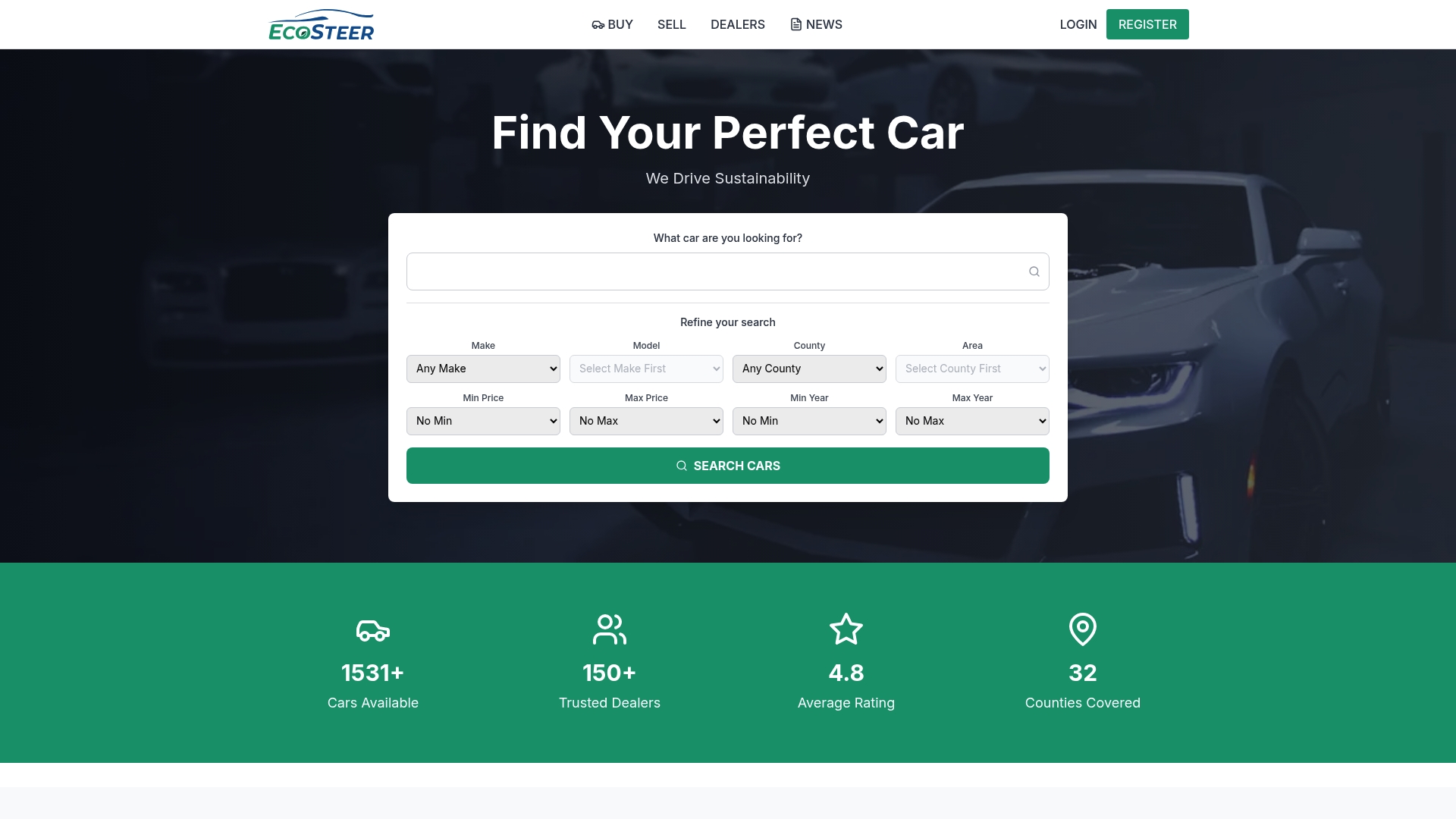
Sellers can keep vehicle history details, service records, and pricing notes attached directly to a listing, ready to send the moment a buyer questions your figure. A messaging system that keeps every offer and counteroffer in one thread makes it far easier to compare simultaneous offers fairly during a collection window, and to produce a clear record if a deposit dispute ever comes up later. For dealers managing multiple listings at once, that same structure supports the kind of fast, documented lead management that turns a five-minute follow-up into a closed sale rather than a missed one.
If you’re weighing up whether to sell privately or take a trade-in, it’s worth reading through the trade-in versus private sale breakdown before you list. When you’re ready, list your car on Ecosteer and put these negotiation tactics to work from your very first enquiry.
Sources
For deeper detail on the pricing and paperwork tactics covered above, see Consumer Reports on negotiating car price, Kelley Blue Book’s selling steps, and Ecosteer’s guides on writing a car ad and timing your sale.
- How to negotiate a new car price effectively (Consumer Reports)
- How to sell a car: 10 steps for success (Kelley Blue Book)
- How to Sell a Used Car for Maximum Value (2026)
Recommended
Ecosteer Editorial
Author